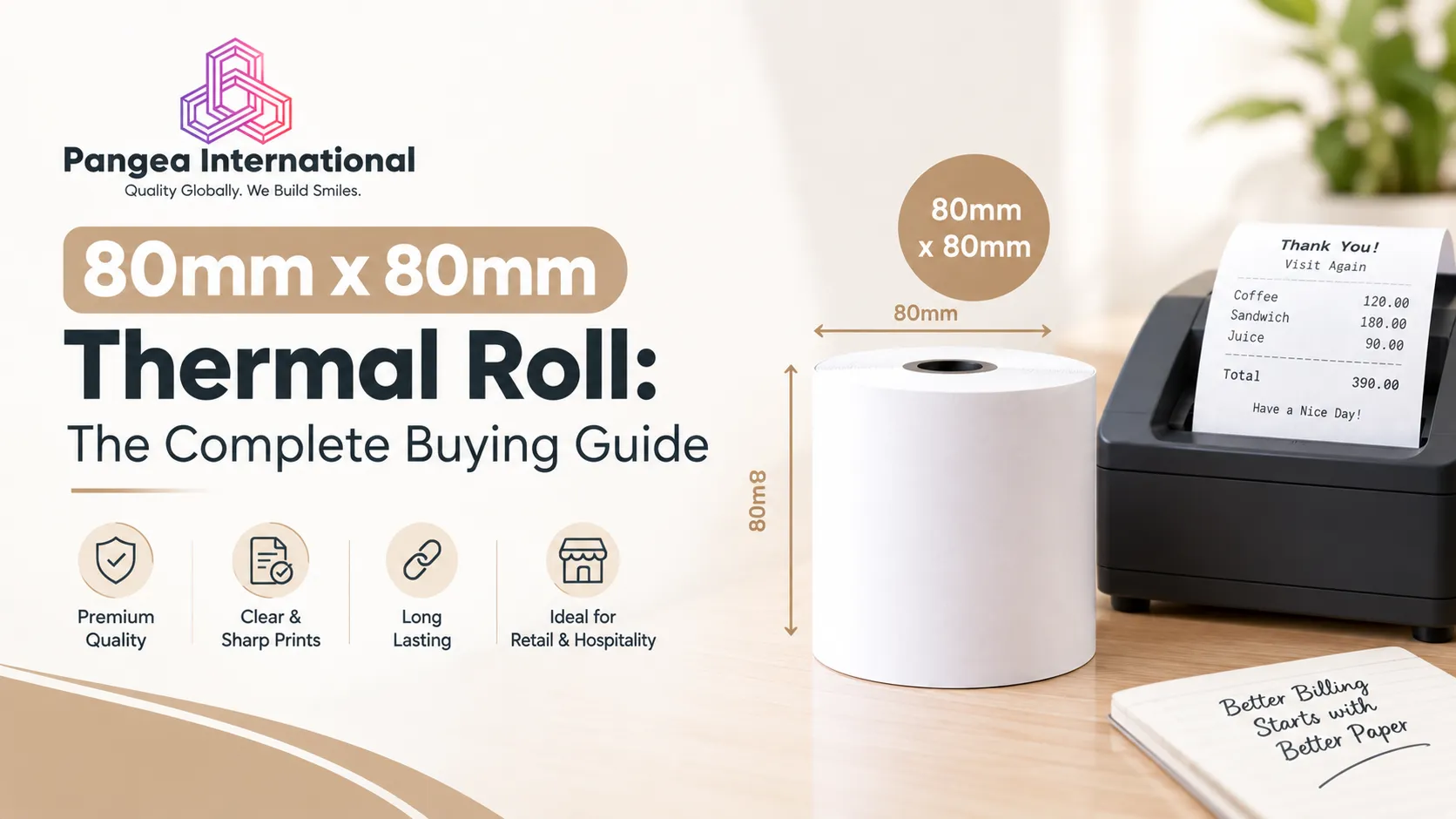
Here's a question worth asking before you place your next order: when a supplier quotes you an 80mm x 80mm thermal roll, do you actually know what both numbers mean? If you assumed the second "80mm" refers to length, you're not alone, and you're also not quite right, and that single misunderstanding is responsible for more mismatched orders and wasted stock than almost anything else in this product category.
We've spent years manufacturing and supplying thermal paper products to retailers, restaurants, and billing counters across Rajkot and Gujarat, and this exact confusion comes up constantly. An 80mm x 80mm thermal roll is defined by its width and its outer diameter, not its length, and once you understand why that distinction matters, choosing the right roll for your printer becomes a lot less guesswork and a lot more straightforward.
Maybe you're reading this because a recent order ran out faster than expected. Maybe you're comparing quotes from a few suppliers and the pricing doesn't quite add up. Either way, what follows isn't a sales pitch dressed up as an article, it's the same explanation we'd walk a customer through on a call, written down so you can reference it whenever you need it.
This guide breaks down exactly what those two numbers mean, how GSM quietly determines how much paper you're actually getting, and how to buy smart so you never end up with a box of rolls that don't fit your printer or run out faster than expected.
What Does "80mm x 80mm" Actually Mean?
Let's clear this up immediately, since it's the single most common point of confusion we hear from first-time buyers. The first 80mm refers to the width of the paper, the dimension that must match your printer's feed slot exactly. The second 80mm refers to the outer diameter of the wound roll, essentially how big around the roll is once it's fully wound onto its core.
This matters enormously because length isn't actually part of the specification at all. Two 80mm x 80mm thermal rolls from different suppliers, both correctly labelled, can contain meaningfully different lengths of paper, because length depends on how thick the paper itself is. A thinner, lower-GSM paper wound to an 80mm diameter fits more metres than a thicker, higher-GSM paper wound to the exact same diameter.
Think of it like a ball of string. If you wind a thin string into a ball roughly the size of a tennis ball, you'll fit considerably more length in than if you wind a thick rope into a ball of the same size. The outer size stays constant, the diameter, but the actual usable length inside varies with thickness. An 80mm x 80mm thermal roll works exactly the same way, and understanding this is the first step toward buying this product intelligently rather than by guesswork, comparing suppliers on genuine value rather than on numbers that look similar but don't actually tell you what you need to know.
Why This Confusion Costs Businesses Money
You might be thinking: does it really matter if I don't know the exact length, as long as the roll fits my printer? Here's why it does. If you're comparing prices between two suppliers both quoting an 80mm x 80mm thermal roll, and one is noticeably cheaper, that price difference might simply reflect a thinner paper with less usable length, not a genuine bargain.
Here's what getting this wrong actually costs, beyond the sticker price:
-
Hidden cost per metre: A cheaper roll with less actual paper length means more frequent reloading and a higher true cost per receipt, even though the shelf price looks lower.
-
Unexpected reorder frequency: Businesses that don't account for length variation between suppliers often find themselves reordering more often than budgeted, without understanding why.
-
Wasted comparison shopping: Without knowing the actual length behind the diameter, comparing quotes from different suppliers becomes almost meaningless, since you're not comparing like for like.
### A Simple Example Worth Understanding
Say Supplier A quotes an 80mm x 80mm thermal roll at 48 GSM, and Supplier B quotes the same nominal size at 60 GSM. Because the diameter is identical but the paper thickness differs, Supplier A's roll will typically contain a longer length of paper than Supplier B's, since thinner paper winds more tightly into the same outer size. If Supplier B is priced lower per roll but contains meaningfully less paper, it might actually be the more expensive option once you calculate true cost per metre.
Let's put real numbers on this to make it concrete. Suppose Supplier A's 48 GSM roll contains 78 metres and costs 45 rupees, working out to roughly 0.58 rupees per metre. Supplier B's 60 GSM roll, priced at a seemingly cheaper 40 rupees, actually contains only 58 metres, working out to roughly 0.69 rupees per metre. Despite the lower sticker price, Supplier B is the more expensive option once you account for actual usable paper, a difference that would be completely invisible if you only compared the price per roll printed on each quote.
This kind of hidden cost is exactly why sophisticated procurement teams at larger retail chains have started requiring suppliers to quote price per metre as standard practice, rather than accepting price per roll as the only comparison point. It takes one extra question to ask for this figure, and it can meaningfully change which supplier actually offers the better deal.
GSM and Length: How Thickness Determines How Much Paper You Actually Get
GSM, or grams per square metre, measures paper thickness and weight. For an 80mm x 80mm thermal roll, common GSM grades run from 48 GSM on the lighter end up to 70-75 GSM on the heavier, premium end, and this single number has an outsized effect on how much actual paper you're getting inside that fixed 80mm diameter.
As a rough guide, a lighter 48-50 GSM roll wound to an 80mm diameter typically yields somewhere in the range of 75-80 metres of usable paper, while a heavier 65-70 GSM roll of the same diameter yields closer to 55-60 metres, since the thicker paper takes up more physical space per wind. These figures vary somewhat by manufacturer and core size, but the underlying relationship, thicker paper means less length at the same diameter, holds consistently across this product category.
This is exactly why asking a supplier "how many metres is this roll?" is just as important as confirming the width and diameter. An 80mm x 80mm thermal roll quoted without a stated length or GSM leaves you genuinely unable to compare it fairly against a competing quote, no matter how confident the pricing sounds.
It's worth noting that the relationship between GSM and length isn't perfectly linear, since factors like winding tension and core diameter also play a role in exactly how much paper fits within a given outer diameter. Two manufacturers using slightly different production equipment can produce a meaningfully different actual length even at the same stated GSM and diameter, which is one more reason a physical sample, rather than a specification sheet alone, remains the most reliable way to verify what you're actually getting before committing to a large order.
80mm x 80mm Thermal Roll vs Other Common Sizes
Diameter isn't the only variable that changes across this product family. Understanding how the most common configurations compare helps you recognise immediately whether a quoted specification actually suits your printer, or whether you're being offered something meant for a different machine entirely.
|
Configuration |
Typical Use |
Approximate Length (at mid-range GSM) |
|
80mm width x 80mm diameter |
Standard countertop POS printers, supermarkets, restaurants |
55-80m depending on GSM |
|
80mm width x 60mm diameter |
Compact printers with smaller paper compartments |
30-40m depending on GSM |
|
57mm width x 40mm diameter |
Handheld card machines, taxi meters |
10-15m depending on GSM |
|
57mm width x 50mm diameter |
Slightly larger handheld or portable printers |
20-25m depending on GSM |
The 80mm x 80mm configuration is by far the most widely used across general retail and hospitality billing counters in India, largely because it strikes a practical balance between roll size and how often staff need to reload the printer during a busy trading day. Before ordering in bulk, always confirm your printer's maximum roll diameter, since a genuine 80mm outer diameter roll simply won't fit inside a compartment designed for something smaller.
Core Diameter: The Overlooked Spec That Causes Most Jams
Width and outer diameter get most of the attention, but core diameter, the size of the cardboard or plastic tube at the centre of the roll, is just as important and far more often overlooked. An 80mm x 80mm thermal roll typically comes with a core diameter of 12mm, 17mm, 22mm, or 25mm, depending on the printer it's designed for.
Load a roll with the wrong core size onto a spindle it doesn't properly fit, and you'll get wobble, uneven feeding, and a meaningfully higher jam rate, even though the width and outer diameter both look correct on paper. This is one of the most common reasons a business assumes a supplier's paper is "just lower quality" when the real issue is simply a core size mismatch that was never checked before ordering, an easy mistake to make since core diameter is rarely printed as prominently on packaging as width and outer diameter are.
Before placing a bulk order, measure your printer's spindle directly or check the manual, and confirm the exact core diameter alongside width and outer roll size. All three need to match, not just one or two of them.
It's also worth noting that core diameter mismatches are among the harder problems to diagnose after the fact, since a slightly oversized or undersized core doesn't always cause an immediate, obvious failure. Sometimes the printer will feed reasonably well for the first several receipts before the accumulated wobble causes a jam partway through the roll, which can make it look like an intermittent, unpredictable fault rather than what it actually is: a straightforward specification mismatch that was there from the very first receipt printed.
BPA-Free 80mm x 80mm Thermal Roll: Why It Matters
Standard thermal coating has historically relied on Bisphenol A, or BPA, a chemical developer now restricted across the EU and several US states due to health concerns tied to repeated skin contact. Staff handling receipts dozens or hundreds of times throughout a shift face the highest cumulative exposure of anyone in a retail or hospitality business.
A BPA-free roll costs only marginally more than standard stock these days and performs identically in terms of print speed and darkness. For businesses in food service, healthcare, or those supplying receipts to health-conscious customers, BPA-free compliance is increasingly a baseline expectation, and it's worth asking every supplier directly rather than assuming all thermal paper is manufactured the same way. Pangea Retails supplies its full range, including every 80mm x 80mm thermal roll we produce, as 100% BPA-free, with documentation available on request for any business or institutional buyer who needs it as part of a vendor evaluation process.
How Does Thermal Printing Actually Work?
It helps to understand the mechanics, since it explains almost every quality issue you'll ever encounter with this product. Every printer using an 80mm x 80mm thermal roll relies on direct thermal printing: a row of tiny heating elements in the print head activates at precise points as the paper feeds past, triggering a chemical reaction between a dye and a colour developer built into the coating. No ink cartridge, no ribbon, no moving parts beyond the paper feed mechanism itself.
This is why thermal printing is so fast and quiet compared to older impact or dot-matrix printers, and it's also why coating quality matters so much. A well-manufactured roll reacts evenly across its entire length, producing consistently dark, legible text from the first receipt to the last. An inconsistent, budget-grade coating can start strong and fade toward patchy, grey text partway through a roll, exactly the kind of quality drift that's easy to miss until a customer complains.
Understanding this mechanism also explains why storage conditions matter so much. If a roll has been sitting somewhere hot for an extended period, part of the coating can pre-react from ambient heat alone, producing faint grey patches even before it's ever loaded into a printer.
Troubleshooting: Why Does My Printer Keep Jamming or Printing Faint Receipts?
Let's work through this like a checklist, since most complaints we hear about this product fall into a handful of predictable categories.
Faint or patchy printing straight out of the box usually points to inconsistent coating quality rather than a printer fault. Before assuming your machine needs servicing, try a roll from a different, known-reliable batch for comparison.
Frequent jams despite correct width typically traces back to a core diameter mismatch, causing enough wobble in the feed mechanism to disrupt smooth printing over a busy shift, even when the width and outer diameter both look correct.
Receipts fading within days rather than weeks generally means either a lower-grade coating than expected or poor storage conditions, particularly relevant during humid or hot months when heat exposure accelerates the natural fading process.
Running out of paper faster than expected almost always traces back to the length confusion covered earlier in this guide. If your new supplier's roll runs out noticeably sooner than your previous one, despite both being labelled the same nominal size, ask directly about GSM and actual metres rather than assuming something is wrong with the printer, and compare the two side by side using the true cost-per-metre method described in the advanced tips section below.
If you manage multiple counters or locations and notice the same issue appearing across several at once, that's a strong signal the problem lies with a specific batch or specification, not the printers themselves, and it's worth raising directly with your supplier rather than troubleshooting each machine individually.
A Buyer's Quick-Reference Glossary
If you're new to sourcing this category of paper, a few terms come up repeatedly in supplier conversations that are worth understanding before you're on a call trying to place your first order. Getting comfortable with this vocabulary early saves considerable back-and-forth once you're actually negotiating specifications and pricing with a potential supplier.
-
Direct thermal: The printing technology used by virtually all modern POS and billing printers, where heat directly activates the coating without any ribbon or ink cartridge involved.
-
GSM: Grams per square metre, the standard measure of paper weight and thickness, directly tied to both durability and how much length fits within a given roll diameter.
-
Outer diameter: The overall size of the wound roll, the second number in a specification like 80mm x 80mm, which must fit within your printer's paper compartment.
-
Core diameter: The size of the cardboard or plastic tube at the centre of the roll, which must match your printer's spindle exactly.
-
BPA-free: Coating manufactured without Bisphenol A, an increasingly standard expectation for institutional and health-conscious buyers.
-
Cost per metre: The true cost comparison metric for this product category, calculated by dividing roll price by actual usable length, rather than comparing price per roll alone.
Walking into a supplier conversation already familiar with these terms tends to produce faster, more precise quotes, since you can specify exactly what you need rather than relying on the supplier to guess based on a vague description of your printer.
Building a Long-Term Supply Relationship, Not Just a One-Time Order
There's a meaningful difference between finding a supplier for a single order and building a relationship that actually supports your business as it grows. The businesses that get the most value from their paper sourcing tend to treat it less like a series of one-off transactions and more like an ongoing operational partnership.
What does that look like in practice? A supplier who remembers your exact specification, GSM, length, core size, without needing it re-explained every time you reorder. Proactive communication about potential supply disruptions before they become your emergency. Transparent, consistent quoting that always states actual length and GSM upfront, rather than leaving you to ask for it every single time.
It also means honesty about what you're actually buying. A supplier who quotes an 80mm x 80mm thermal roll without volunteering the GSM or length, hoping you won't ask, isn't someone building a long-term relationship, they're optimising for a single transaction. The suppliers worth sticking with are the ones who provide this information proactively, before you even have to request it.
Environmental Considerations
Sustainability is becoming a more visible purchasing factor across this category, not just a marketing checkbox. Standard thermal-coated paper is genuinely difficult to recycle through conventional paper streams because of its chemical coating, a challenge shared across every business using this product regardless of scale.
Choosing a well-manufactured, consistent roll indirectly reduces waste, since fewer misprints and reprints occur compared to inconsistent, budget-grade stock that fades or jams partway through a busy shift. Some larger retail chains, particularly those with broader ESG reporting commitments, have started asking suppliers directly about base paper sourcing and coating chemistry as part of standard vendor evaluation, treating it as one measurable line item within a larger sustainability framework.
How to Choose the Right 80mm x 80mm Thermal Roll for Your Business
Let's make this practical. Here's the process worth working through before placing an order.
Confirm your printer's exact requirements first. Width, maximum outer diameter, and core diameter all need to match precisely, not just the width alone, since even a correctly sized width won't help if the roll is too large to physically close the printer's lid.
Ask for length, not just diameter. As covered above, two rolls of the same nominal size can contain meaningfully different lengths depending on GSM, so always confirm the actual metres you're getting.
Match GSM to how long receipts need to stay legible. Lighter grades suit high-turnover counters with short-lived receipts. Heavier grades suit businesses needing receipts to remain legible for weeks.
Ask about BPA-free certification. A simple question that separates suppliers who take quality seriously from those who don't.
Request a sample before bulk ordering. A test roll run through your actual printer tells you more in five minutes than any specification sheet ever could.
Here's a quick checklist worth keeping on hand:
-
[ ] Confirm width, outer diameter, and core diameter all match your printer
-
[ ] Ask for the actual length in metres, not just the diameter
-
[ ] Decide on GSM based on transaction volume and legibility needs
-
[ ] Ask specifically about BPA-free certification and documentation
-
[ ] Request a sample before committing to a bulk order
-
[ ] Calculate true cost per metre, not just cost per roll, when comparing quotes
-
[ ] Confirm GST-compliant invoicing is available
Real-World Examples: Where This Size Is Actually Used
It helps to see how different businesses use this specific configuration day to day, since it's genuinely one of the most common sizes in general commercial use.
-
Supermarkets and grocery stores: High transaction volume, detailed itemised bills, typically running this size on countertop billing printers across multiple checkout lanes.
-
Restaurants and cafes: Both customer-facing receipts and, often, a separate kitchen order printer running the same general paper category.
-
Self-service kiosks: Ticketing, ordering, and payment kiosks that print a confirmation slip after each transaction.
-
Pharmacies: Prescription slips and billing receipts where legibility over several weeks genuinely matters.
-
Retail chains with multiple checkout lanes: Consistent sizing across every till reduces the risk of staff loading the wrong stock into the wrong printer.
Each of these businesses is solving a slightly different problem, but all of them share the same underlying requirement: a roll that fits, prints clearly, and gives them a predictable amount of usable paper per order.
It's worth noticing something else in that list too: the businesses with the highest transaction volumes, supermarkets, busy restaurants, multi-lane checkout operations, are also the ones with the most to gain from understanding the true cost-per-metre calculation covered earlier. A small per-metre difference that seems trivial on a single roll compounds into a genuinely significant amount once you're consuming hundreds or thousands of rolls a year across a large operation. For a single-counter business, this level of precision might feel like overkill; for a multi-location chain, it's often the difference between a controlled, predictable paper budget and one that quietly creeps upward every quarter without anyone quite understanding why.
Case Study: How a Gujarat Supermarket Chain Fixed Its Reordering Confusion
A regional supermarket chain operating across several Gujarat towns came to us with a puzzling problem: despite ordering what looked like the same specification every time, their reorder frequency kept fluctuating unpredictably, and nobody could quite explain why some batches seemed to run out faster than others.
After reviewing their purchase history, the issue became clear. The chain had been sourcing from multiple vendors, all quoting an "80mm x 80mm thermal roll," but none of the vendors were disclosing GSM or actual length consistently. Some batches were 48 GSM with genuinely longer usable length, others were 65 GSM with meaningfully less paper per roll, despite both looking identical in packaging and diameter.
We worked with the chain to standardise on a single, clearly documented specification, GSM, length, and core size all fixed and confirmed in writing, sourced centrally rather than through scattered vendors quoting inconsistent information. Within one reorder cycle, the chain's consumption became predictable for the first time, and because they were now comparing true cost per metre rather than cost per roll, they identified a further 10% saving simply by switching to a slightly higher-GSM option that, despite costing a little more per roll, lasted long enough to reduce their total annual order volume.
Six months on, the finance team reported that reorder forecasting had become genuinely predictable for the first time in years, since every store now consumed paper at a consistent, documented rate rather than the unpredictable pattern caused by mismatched batches from different vendors. The chain's procurement lead told us the real lesson wasn't about paper at all, it was a reminder that any recurring purchase category deserves the same specification discipline, regardless of how small or routine it seems on the surface.
Signs Your Current Supplier Isn't Being Transparent
Not sure whether your current supplier is giving you the full picture? A few honest questions can clarify things quickly.
Does your supplier volunteer both GSM and actual length when quoting an 80mm x 80mm thermal roll, or do you have to ask specifically every single time? A supplier who states both figures upfront, without prompting, is generally more trustworthy than one who only mentions diameter and price.
Have you noticed your reorder frequency creeping up over time, even though you believe you're ordering the same specification? This is one of the clearest signs that GSM or length has quietly drifted between batches without anyone flagging the change, and it's worth investigating before it becomes an accepted, unquestioned part of your ordering routine.
Can your supplier answer basic questions about coating chemistry or BPA-free status without hesitation? A vague assurance isn't the same as an actual specification sheet or test documentation.
Finally, does comparing quotes between suppliers feel unnecessarily difficult, with some quoting price per roll and others per carton, and none stating actual length? A transparent supplier makes this comparison simple by default, not something you have to extract through repeated follow-up questions, and their willingness to volunteer this information upfront is usually a good early signal of how the rest of the relationship will go.
Advanced Tips for Buying This Product at Scale
### Calculating True Cost Per Metre
Never compare quotes purely on price per roll. Ask each supplier for the exact length in metres at the GSM they're quoting, then divide the roll price by that length to get a genuine cost-per-metre figure. This single calculation exposes pricing games that a simple per-roll comparison completely misses.
Keep a simple spreadsheet tracking this figure across every supplier you evaluate and every quote you receive over time. It takes only a few minutes to set up, and it turns what would otherwise be a series of one-off, hard-to-compare quotes into a genuinely useful historical record you can reference the next time you're negotiating pricing or considering a switch to a different supplier entirely.
### Bulk Buying and Storage
Consolidating purchases into a single scheduled bulk order typically reduces per-unit cost by somewhere in the range of 12-18%, based on what we've seen across businesses that make this switch. Store stock away from direct sunlight, heat, and humidity, all of which degrade thermal coating and can cause premature fading even before a roll is ever loaded into a printer, particularly relevant during Gujarat's monsoon months.
A practical guideline worth adopting: forecast roughly one to two months of stock ahead based on your actual historical metre consumption, rather than simply reordering when a rough visual check of remaining stock suggests you're running low. This is considerably more precise once you're tracking consumption in metres rather than counting remaining rolls, since a partially used roll can be deceptively difficult to estimate by eye alone.
### GST and ITC Considerations
For GST-registered Indian businesses, an 80mm x 80mm thermal roll purchased for business use generally falls under HSN code 4811, and Input Tax Credit can typically be claimed provided you hold a valid GST invoice from a registered supplier. Always request one, every time, even for smaller top-up orders.
Common Mistakes When Buying 80mm x 80mm Thermal Roll
Assuming the second number is length. As covered throughout this guide, it's diameter, and confusing the two leads to unrealistic expectations about how much paper you're actually getting.
Comparing price per roll instead of price per metre. Without knowing actual length, a cheaper-looking quote can easily be the more expensive option once you calculate true cost.
Ignoring core diameter. Width and outer diameter both looking correct doesn't guarantee a proper fit if the core size doesn't match your printer's spindle.
Not asking about BPA-free certification. An increasingly relevant question that a serious supplier should answer immediately, with documentation available on request.
Buying reactively instead of on a schedule. Emergency small purchases cost more per unit and increase the odds of inconsistent quality across repeat orders.
Not documenting the agreed specification in writing. A verbal understanding about GSM and length, confirmed once and never revisited, tends to quietly drift over subsequent orders unless it's written down and referenced every time a new batch arrives.
Assuming all suppliers calculate GSM the same way. Minor variations in testing methodology between manufacturers can produce slightly different stated GSM for what is functionally similar paper, so treat GSM as a useful guide rather than an absolutely precise, universally standardised figure across every single supplier.
Custom Printing and Branding on This Size
Beyond plain white stock, an 80mm x 80mm thermal roll can also be manufactured with pre-printed branding, a business's logo, a return policy, a loyalty programme QR code, or promotional messaging printed along the edge or as a footer on every receipt. For retail chains and franchises looking to reinforce brand identity at every single transaction, this is a low-cost way to turn a purely functional item into a small marketing touchpoint.
Custom printing does typically require a higher minimum order quantity than plain stock, since it involves a dedicated production run rather than pulling from standard inventory. Businesses considering this option should plan further ahead than they would for a routine reorder, and confirm turnaround times with their supplier before committing to a launch date tied to the custom-printed stock actually arriving on site.
It's also worth asking whether custom printing affects the underlying specification in any way. A well-manufactured custom roll should maintain the same width, diameter, GSM, and BPA-free coating as the standard product, with only the printed branding added as a genuinely separate layer, not a compromise on the paper quality itself.
Some businesses worry that custom printing might reduce the actual usable length compared to a plain roll of the same diameter, since the branding process theoretically adds a thin layer to the paper. In practice, with a well-run production process, this difference is negligible and shouldn't meaningfully change the length calculations covered earlier in this guide. If a supplier's custom-printed option shows a noticeably shorter length than their plain stock at the same GSM and diameter, that's worth asking about directly rather than assuming it's simply an unavoidable trade-off of custom branding.
How Seasonal Demand Affects Your Ordering Strategy
Transaction volumes across retail and hospitality businesses in India tend to spike noticeably around festival seasons, particularly Diwali, and again during end-of-year sales periods. Businesses that don't build this seasonality into their reorder planning sometimes find themselves scrambling for stock precisely when demand across the entire market is highest and supplier lead times are longest.
A practical approach many of our customers use is reviewing consumption data from the same period in the previous year and building in a reasonable buffer, typically an extra 15-20% above the calculated baseline, to account for the unpredictable swings that come with festival shopping and promotional events. This is considerably easier to do once you're tracking actual length consumed rather than simply counting rolls purchased, since roll count alone can be misleading if GSM or length varies between orders.
This same logic applies to any business experiencing rapid, predictable growth, not just seasonal spikes. A retail chain opening several new locations within a short window should factor the additional projected consumption into its bulk ordering well ahead of the actual opening dates, rather than treating each new location's first order as a separate, reactive purchase disconnected from the chain's overall consumption planning across its wider network of stores.
Retailers running planned promotions or sales events should treat their paper reorder timeline the same way they'd treat stock replenishment for any other consumable, planning ahead rather than assuming their usual supplier will have unlimited capacity to fulfil an urgent order during the exact week that every other business in the region is also placing emergency orders.
Where to Buy 80mm x 80mm Thermal Roll in India: Why Pangea Retails
Pangea Retails manufactures and supplies this size across the GSM grades and lengths covered throughout this guide, with every specification, width, diameter, core size, and actual length in metres, clearly documented and confirmed in writing before you order. Every roll we produce is 100% BPA-free, backed by GST-compliant invoicing for every order, whether you need ten rolls for a single counter or a pallet-scale monthly supply across a multi-location business.
Sourcing directly from a manufacturer rather than a reseller several steps removed from production means clearer answers about actual length, GSM consistency, and coating quality, plus pricing that improves meaningfully as your order volume grows. You can browse our current stock of the 79mm x 50 Mtr POS Roll on the Pangea Retails shop page, and reach out directly to confirm exact specifications, including actual length in metres, for your specific printer before placing a bulk order.
For related buying guidance, our thermal receipt paper roll guide and our piece on why every business should switch to BPA-free paper are both useful companion reads.
Frequently Asked Questions About the 80mm x 80mm Thermal Roll
Does the second 80mm mean length or diameter?
It means diameter, the outer size of the wound roll, not length, which is why two rolls of this same nominal size can contain different amounts of usable paper depending on GSM.
How many metres does an 80mm x 80mm thermal roll actually contain?
It depends on GSM, but typically ranges from roughly 55 metres at heavier 65-70 GSM grades up to around 80 metres at lighter 48-50 GSM grades, since thinner paper winds more tightly into the same diameter.
What core size does an 80mm x 80mm thermal roll need?
Common core diameters include 12mm, 17mm, 22mm, and 25mm, and you should always confirm this against your specific printer's spindle rather than assuming any core size will fit.
Is a BPA-free version of this roll available in India?
Yes, Pangea Retails supplies every 80mm x 80mm thermal roll as 100% BPA-free, with test documentation available on request for business and institutional buyers.
Can I claim GST input tax credit on this purchase?
Yes, GST-registered businesses can typically claim Input Tax Credit on an 80mm x 80mm thermal roll purchased for business use, provided the order is supported by a valid GST invoice from a registered supplier.
Conclusion: Know What You're Actually Buying, and Everything Else Gets Easier
At the end of the day, an 80mm x 80mm thermal roll is defined by two numbers that most buyers assume they understand but often don't, width and diameter, not width and length. Once you know what you're actually comparing, GSM, actual metres, core size, and coating quality, choosing the right supplier stops being guesswork and becomes a straightforward, informed decision.
We know this level of detail might seem like more than most people expect from a paper roll buying guide, but that's exactly the point. The businesses that never think about this product again, the ones who solve it once and move on, are the ones who took the time to understand these numbers upfront rather than assuming a lower quoted price automatically meant a better deal.
Pangea Retails has built its entire thermal paper supply around exactly this kind of transparency, so businesses across Rajkot and Gujarat can order with confidence rather than confusion. If you're ready to standardise your supply or simply want a sample before committing to a bulk order, our team is ready to confirm the exact specification your printer needs, including the actual length you'll be getting at whatever GSM you choose. Reach out today, and let's make sure you always know exactly what you're getting.