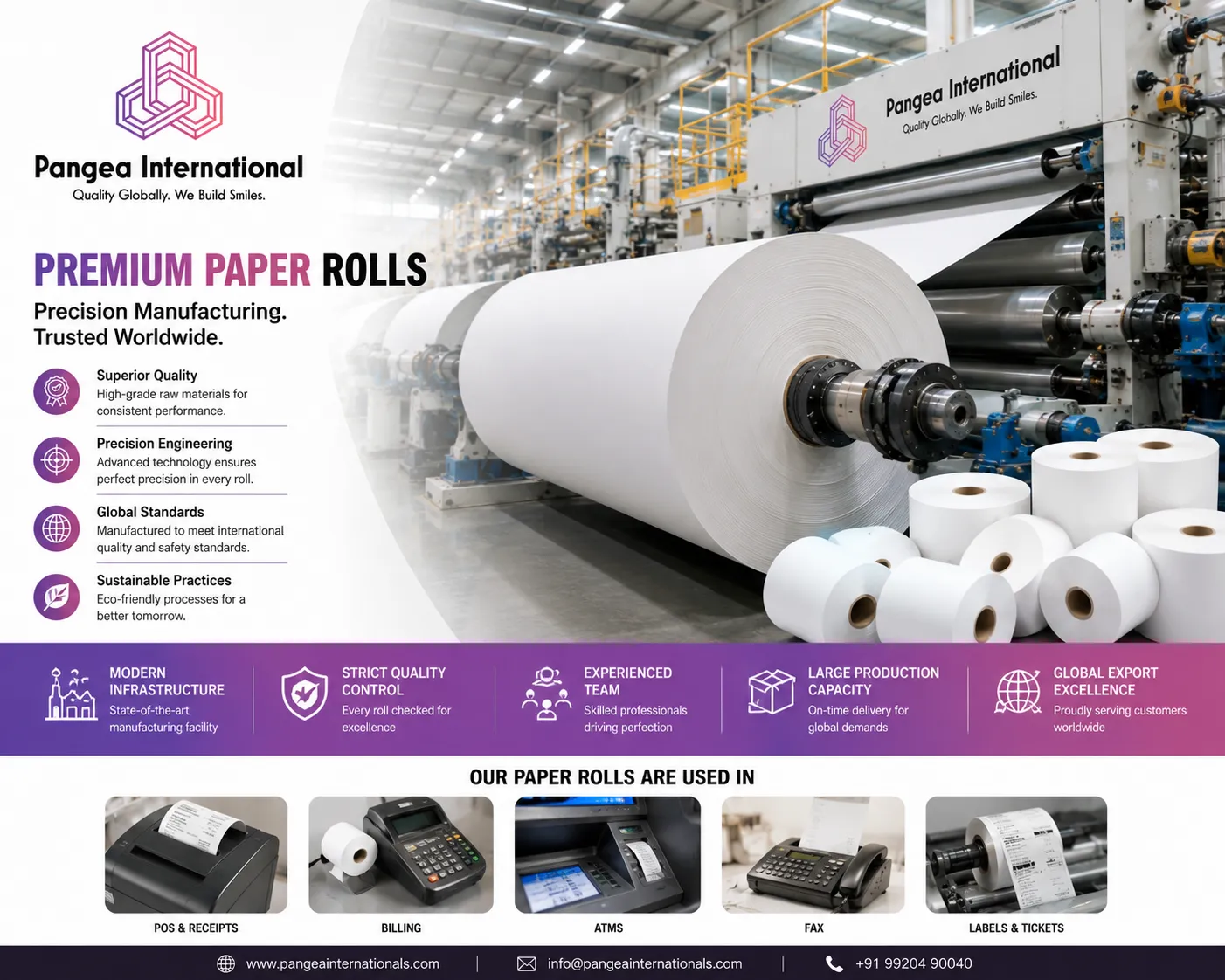
Picture this: a customer walks up to an ATM, keys in their PIN, withdraws cash, and waits for that little transaction slip to print. Except it doesn't. The machine flashes a paper-out error, the customer walks away irritated, and somewhere in a back office, someone has to log a service ticket for something that should never have been a problem in the first place. That "something" is almost always the ATM paper roll, and it is a lot more important than its size suggests.
We have spent years supplying thermal paper products to retailers, banks, and payment networks across Rajkot and Gujarat, and if there is one lesson that keeps repeating, it is this: this product looks like a commodity item right up until the wrong one causes a machine outage, a compliance headache, or an unhappy customer standing in front of a screen that just won't print. This guide exists to make sure that never happens to you.
Maybe you're reading this because a service ticket landed on your desk this week. Maybe you're setting up a new machine or expanding a fleet and want to get the sourcing right from day one. Either way, what follows isn't a sales pitch dressed up as an article, it's the same walkthrough we'd give a customer on a call, written down so you can reference it whenever you need it.
By the end of this article, you will understand exactly what an ATM paper roll is, how it differs from ordinary POS paper, what specifications actually matter, and how to buy smart so your machines never sit idle over something this avoidable.
What Is an ATM Paper Roll, Exactly?
Let's start with the basics. An ATM paper roll is the thermal paper loaded inside an automated teller machine's receipt printer, producing the transaction slip a customer receives after a withdrawal, balance enquiry, or deposit. It works the same way as other thermal paper: a heat-sensitive coating reacts to the printer head, producing dark text with zero ink or toner involved.
Here's the thing most people don't realise: not all rolls are created equal. Some are thermal, reacting to heat from the printer head with no ink involved at all. Others are plain bond paper, printed using an impact or dot-matrix mechanism, though this is increasingly rare in modern ATM deployments. Each type suits a different kind of machine, and using the wrong one is a bit like trying to fit a square peg into a round hole; it might look close enough, but it simply will not work properly, no matter how carefully you try to force it. An ATM paper roll typically needs to survive far higher duty cycles, tighter mechanical tolerances, and stricter print-legibility requirements than a shop counter ever demands. Banks cannot afford a machine going down because of a paper jam, especially not one sitting in a high-footfall location processing hundreds of withdrawals a day.
Think of it this way: a regular billing roll is like a bicycle tyre, replaced often, low stakes if something's slightly off. An ATM paper roll is closer to a commercial vehicle tyre, built to a tighter spec, expected to perform reliably under sustained load, because the cost of failure is simply higher.
Why ATM Paper Roll Choice Is a Bigger Deal Than You'd Think
You might assume paper is paper. Fair assumption, until you look at the numbers behind India's ATM network. According to RBI data, India's point-of-sale and self-service payment infrastructure has expanded rapidly in recent years, with digital and cash-based transaction volumes both climbing steadily even as UPI dominates day-to-day spending. ATMs remain a critical cash access point across the country, particularly in semi-urban and rural areas where digital payment penetration is still catching up.
Every single one of those machines depends on a correctly specified roll to complete a transaction the customer can actually walk away with proof of. Get the paper wrong, and you're not just risking a jam, you're risking a service call, a technician visit, and in many cases, a machine sitting out of service for hours while someone sources the right replacement. Multiply that by even a modest fleet of machines, and the cumulative cost of inconsistent paper sourcing starts to look a lot less trivial than the per-roll price tag would suggest.
Here's what a poorly chosen roll actually costs a bank or ATM operator, beyond the invoice price:
-
Downtime cost: Every non-functioning ATM is lost transaction revenue and a frustrated customer who may simply walk to a competitor's machine next time.
-
Technician call-outs: A wrong core size or incompatible winding direction often means an on-site service visit just to fix what should have been a five-minute paper swap.
-
Compliance risk: Banking regulations in many cases require legible transaction records retained for extended periods, and a poor-quality ATM paper roll that fades too quickly can complicate dispute resolution later.
### The Hidden Cost of Getting This Wrong
Here's an analogy worth sitting with: choosing the cheapest, unverified ATM paper roll is a bit like choosing the cheapest tyres for an ambulance. It might work fine ninety-nine times out of a hundred, but the one time it doesn't is the time that actually matters, and by then, the damage is already done.
We've spoken with ATM operators who assumed any roll labelled "ATM paper" was interchangeable, only to discover the winding direction was wrong for their machine model, an entire batch that looked fine on the shelf but wouldn't feed correctly once loaded.
ATM Paper Roll vs POS Roll vs Billing Machine Roll: What's the Difference?
New buyers often use these terms interchangeably, and honestly, in casual conversation, that's fine. But when you're placing an actual order, the distinction matters more than you'd expect.
|
Term |
Typical Width |
Typical Length |
Key Distinguishing Feature |
|
ATM paper roll |
80mm (most common), also 76mm, 58mm |
Often 150m-250m+, far longer than POS rolls |
Built for high durability, sense marks, CSI/CSO winding |
|
POS roll |
57mm or 79mm/80mm |
15m-50m |
Shorter, lower duty cycle, handheld or countertop |
|
Billing machine roll |
Varies by machine, general term |
Varies |
Umbrella term covering thermal, carbonless, and plain paper |
An ATM paper roll is engineered for a fundamentally different duty cycle than a shop counter's billing roll. Where a retail printer might churn through a 25-metre roll in a busy afternoon, an ATM can run for weeks on a single, much longer roll, precisely because replacing it requires either a technician visit or specially trained branch staff, not just whoever's standing at the counter.
ATM Paper Roll Sizes and Specifications: The Complete Chart
Getting specifications right matters more here than almost anywhere else in the thermal paper category, because a mismatched roll doesn't just jam, it can trigger a full service call. Unlike a shop counter, where a staff member can simply swap in a different roll from a nearby box, an ATM often requires a trained technician or authorised branch staff member to open the machine and reload it correctly, which turns a paper mistake into a genuine logistical event rather than a thirty-second fix.
|
Specification |
Common Values |
Why It Matters |
|
Width |
80mm (industry standard), 76mm, 58mm |
Must match the printer's feed mechanism exactly |
|
Core diameter |
17mm, 20mm, 25mm |
Determines fit on the machine's spindle |
|
Outer roll diameter |
150mm, 180mm, 200mm, 250mm |
Must fit within the printer's paper compartment |
|
Roll length |
Often 150-250 metres, sometimes longer |
Longer rolls mean fewer branch visits or service calls |
|
GSM |
48-80 GSM |
Heavier grades resist tearing and hold print quality longer |
Two details deserve special attention, because they're specific to this category and rarely come up when buying ordinary POS paper, yet they're responsible for the vast majority of compatibility complaints we hear from first-time institutional buyers.
CSI vs CSO winding. ATM printers load paper either "coated side in" (CSI) or "coated side out" (CSO), depending on the machine's internal mechanism. Load the wrong winding direction, and the printer simply won't produce a legible receipt, even though the width and GSM are both correct. Always confirm which winding your specific ATM model requires before ordering.
Sense marks. Many machines rely on printed sense marks, small black marks along the edge of the roll, to trigger an automatic cut after each receipt. An ATM paper roll without the correct sense mark spacing for your machine model can cause misaligned cuts or failure to cut entirely.
GSM and Durability: Why This Category Works Harder Than Regular Receipt Paper
GSM tells you how thick and durable the paper is, and for an ATM paper roll, this matters more than it does for a shop receipt that gets glanced at once and thrown away.
Lighter grades, around 48-55 GSM, are sometimes used in lower-volume kiosk or mini-ATM applications where cost efficiency matters more than long-term archival quality. Heavier grades, 65-80 GSM, are the norm for standard bank ATMs, since these machines print thousands of transaction slips before a roll is replaced, and the paper needs to feed smoothly and print clearly across that entire duty cycle without degrading.
Coating quality matters just as much as GSM here. A well-coated ATM paper roll produces consistently dark, legible text across the full length of a long roll, while an inconsistent, budget-grade one can start strong and fade toward patchy, grey text by the time you're a hundred metres in, exactly the kind of quality drift that's hard to catch until customers start complaining.
Machine Compatibility: NCR, Diebold, Hyosung, and What It Actually Means for You
Most ATMs in India and globally run on hardware from a handful of major manufacturers, NCR, Diebold Nixdorf, Hyosung, and Wincor among them, and each has its own quirks around paper specification.
This is why "just give me an ATM paper roll" is rarely enough information for a supplier to work with. The machine's brand and model determines the exact width, core size, winding direction, and sense mark spacing you actually need. A roll that's perfect for one manufacturer's machine can be entirely wrong for another's, even if both are labelled generically as "80mm ATM paper."
If you manage multiple ATM locations, potentially running machines from different manufacturers across different branches, it's worth keeping a simple reference sheet mapping each machine model to its exact paper specification. It sounds like a small administrative task, but it prevents the single most common mistake we see: ordering in bulk based on one machine's spec and discovering half the fleet can't use it.
This matters even more during hardware refresh cycles. When a bank or operator upgrades a portion of its fleet to newer machines, it's easy for the paper ordering process to lag behind the hardware change, with staff continuing to order the old specification simply out of habit until someone notices a batch of unusable stock sitting in a storeroom. Building a habit of reviewing your specification sheet whenever hardware changes, not just when problems appear, closes this gap before it becomes expensive.
How to Choose the Right ATM Paper Roll for Your Business
Let's make this practical. Here's the process we walk operators through, whether they're managing a single branch ATM or a network spread across a region.
Start with the machine manual. Every ATM manufacturer specifies exact width, core diameter, winding direction, and sense mark requirements. This single document eliminates almost every compatibility mistake before it happens.
Confirm CSI or CSO winding. As covered above, this is the detail most first-time buyers miss entirely, and it's the single fastest way to end up with an unusable batch.
Think about replacement frequency. High-footfall ATMs benefit from longer rolls that reduce technician visits, while lower-volume kiosk machines can run economically on shorter, lighter-GSM stock.
Ask about BPA-free coating. More on this below, but it's an increasingly relevant question for any institution handling customer-facing paper at scale.
Request a sample before bulk ordering. A test roll run through your actual machine tells you more in five minutes than any specification sheet ever could.
Here's a quick checklist worth keeping handy:
-
[ ] Confirm exact width against your machine's manual (80mm, 76mm, or 58mm)
-
[ ] Confirm core diameter and outer roll diameter both fit your printer compartment
-
[ ] Confirm CSI or CSO winding direction matches your machine
-
[ ] Confirm sense mark spacing if your machine relies on auto-cut
-
[ ] Decide on GSM based on transaction volume and archival needs
-
[ ] Ask whether the coating is BPA-free
-
[ ] Request a sample before committing to a bulk order
-
[ ] Confirm GST-compliant invoicing is available
Real-World Examples: Who Actually Buys ATM Paper Roll in India
It helps to see how different operators actually use this product, because the right specification really does depend on context.
-
Public and private sector banks: High-volume branch and off-site ATMs running heavyweight, long-length rolls built for extended duty cycles between service visits.
-
White-label ATM operators: Independent networks managing machines across multiple brands and locations, often juggling several different specifications simultaneously.
-
Micro-ATM and kiosk operators: Smaller, lower-volume machines in semi-urban and rural areas, typically running lighter-GSM, shorter-length rolls.
-
Retail chains with in-store ATMs: Businesses hosting a bank's machine on their premises, usually working directly with the bank's approved paper supplier.
-
Payment service providers: Companies managing cash recycler and cash deposit machines, which often have their own distinct paper specifications beyond standard withdrawal-only ATMs.
Each of these operators is solving a slightly different problem, but all of them share the same underlying requirement: a dependable ATM paper roll that fits, prints clearly, and doesn't force an unplanned service visit.
Case Study: How a Gujarat ATM Network Solved Its Recurring Downtime Problem
A regional ATM deployment company managing machines across several towns in Gujarat came to us with a familiar complaint: recurring paper-related service tickets, inconsistent print quality across different branches, and rising technician call-out costs eating into their margins.
The root cause, once we looked into it, was that the operator had been sourcing paper from multiple local vendors without standardising on winding direction or sense mark specification across their mixed fleet of NCR and Hyosung machines. Some machines were being loaded with rolls wound the wrong way, producing blank or unreadable receipts that technicians then had to diagnose and fix on-site.
We worked with the operator to map each machine model to its exact specification and standardised their ATM paper roll procurement into two clearly documented categories, one for their NCR fleet and one for Hyosung, both sourced centrally rather than through scattered local purchases. Within two months, paper-related service tickets dropped by close to 70%, and because orders were now consolidated rather than fragmented across vendors, per-unit costs fell by roughly 14% as well.
The operator's ops manager told us the biggest relief wasn't even the cost savings, it was no longer having to train every technician on which paper went with which machine, since the specification was now documented and centrally sourced.
A smaller but related example: one of the branch managers within that same network mentioned that customer complaints about "the ATM ate my card" had actually, on investigation, sometimes been receipt-related confusion, a customer assuming something was wrong with the machine when the real issue was simply a blank or unreadable receipt caused by incorrect winding direction. Once the fleet was standardised, those specific complaints dropped to essentially zero, a small but telling reminder that paper problems don't always announce themselves as paper problems from the customer's side of the counter.
Why Standardisation Matters More as Your ATM Fleet Grows
If you're managing a single machine, a specification mismatch is a minor inconvenience, one technician visit, one afternoon of inconvenience, and it's resolved. Scale that same mismatch across twenty, fifty, or a hundred machines spread across different manufacturers, and the same small oversight compounds into a genuinely significant operational and financial problem.
This is the pattern we see most often with growing ATM networks and white-label operators: paper procurement decisions made early, often by whoever happened to be setting up the first few machines, become informal defaults that nobody revisits as the fleet expands. New branches or machines get added, sometimes with different hardware entirely, and the paper ordering process never catches up to reflect that complexity.
The fix isn't complicated, but it does require someone to actually own it. Maintain a simple, shared specification sheet mapping every machine model in your fleet to its exact paper requirements, width, core, winding direction, and sense mark spacing. Review it whenever new machines are added or an existing model is replaced. It's a five-minute administrative task that prevents exactly the kind of scattered, reactive purchasing that drives up both cost and downtime as a network grows.
Consider, too, building a relationship with a single manufacturer capable of supplying multiple specifications under one account, rather than juggling separate vendors for each machine type. Beyond the pricing advantage of consolidated volume, it also means one point of contact who already understands your entire fleet's requirements, rather than starting from scratch with a new supplier every time a specification question comes up, which saves meaningful time whenever a new machine model is added to the network.
Advanced Tips for Managing ATM Paper Roll Supply at Scale
### Storage That Actually Protects Long Rolls
Because an ATM paper roll is often considerably longer than a standard POS roll, storage conditions matter over a longer timeframe too. Keep stock away from direct sunlight, heat sources, and humidity, all of which degrade thermal coating even before a roll is ever loaded into a machine. In Gujarat's monsoon months, sealed storage or a climate-controlled stockroom meaningfully extends how long a roll retains sharp, legible print quality.
### Bulk Buying and the Real Math Behind It
Consolidating ATM paper roll purchases across multiple branches or machines into a single scheduled order typically reduces per-unit cost by somewhere in the range of 12-18%, based on what we've seen across operators who make this switch, once delivery costs and volume pricing are factored in against scattered, reactive small purchases.
### GST and ITC Considerations
For GST-registered businesses in India, an ATM paper roll purchased for business use generally falls under HSN code 4811, and Input Tax Credit can typically be claimed provided you hold a valid GST invoice from a registered supplier. This applies whether you're a bank's facilities team, a white-label ATM operator, or a retail chain hosting a machine on your premises.
Common Mistakes When Buying ATM Paper Roll (and How to Avoid Them)
Assuming all 80mm rolls are identical. Width alone doesn't guarantee compatibility. Core size, winding direction, and sense marks all need to match too.
Ignoring winding direction entirely. This is, by a wide margin, the single most common cause of "the paper doesn't work" complaints we hear from ATM operators.
Buying reactively instead of on a schedule. Emergency small-batch purchases cost more per unit and increase the odds of a specification mismatch under time pressure.
Not documenting machine-to-specification mapping. If only one person knows which roll goes with which machine, you're one staff change away from a costly guessing game.
Skipping the sample test. A five-minute test print in your actual machine beats trusting a spec sheet every time.
Overlooking sense mark spacing when switching suppliers. Even two suppliers offering what looks like the same nominal specification can place sense marks slightly differently. If you switch vendors without verifying this detail, you may see cutting issues that have nothing to do with paper quality and everything to do with an overlooked spacing mismatch.
Failing to plan for seasonal demand spikes. Transaction volumes, and therefore paper consumption, often rise around festival seasons and salary disbursement periods. Operators who don't build this into their reorder planning sometimes find themselves scrambling for emergency stock precisely when their usual supplier is also busiest.
BPA-Free ATM Paper Roll: Why Banks Increasingly Care
Standard thermal coating has historically relied on Bisphenol A, or BPA, a chemical now restricted across the EU and several US states due to health concerns tied to repeated skin contact. Bank staff, technicians, and customers all handle ATM receipts regularly, and a BPA-free ATM paper roll reduces that cumulative exposure at essentially no meaningful cost difference.
For banking institutions in particular, chemical safety documentation is increasingly part of broader vendor due-diligence processes, especially for institutions with international partnerships or ESG reporting commitments. Being able to confirm BPA-free status with actual test documentation, rather than a vague assurance, is quickly becoming a baseline expectation rather than a nice-to-have.
We cover the underlying chemistry and global regulations in far more depth in our dedicated guide on why every business should switch to BPA-free thermal paper, worth a read if your procurement team needs the full picture.
How Does an ATM Printer Actually Turn Paper Into a Receipt?
It helps to understand what's happening mechanically inside the machine, because it explains almost every quality and compatibility issue you'll ever encounter with this category of paper.
Most modern ATMs use thermal print heads, rows of tiny heating elements that activate at precise points as the paper feeds past. When the coated surface passes under the head, heat triggers a chemical reaction between a dye and a colour developer built into the coating, producing dark text exactly where needed. There's no ink cartridge, no ribbon, and no moving parts beyond the paper feed mechanism itself, which is part of why thermal printing has become the standard across the banking sector.
This mechanism is also why winding direction matters so much for this specific application. If the coated side isn't facing the print head correctly, given the printer's internal paper path, the heat simply won't reach the reactive layer, and you'll get a blank or barely visible receipt even though every other specification checks out. It's a bit like loading a camera with the film facing the wrong way: everything else about the setup can be perfect, and you still won't get a usable result.
Sense marks work through a similar principle of precision. A small optical sensor inside the printer detects the printed black marks along the roll's edge and triggers the cutting mechanism at exactly the right point. Get the spacing wrong, and the machine either cuts mid-receipt or fails to cut at all, jamming the feed mechanism on the next transaction.
Troubleshooting: Why Does My ATM Keep Jamming or Printing Blank Receipts?
Let's work through this like a checklist, because most ATM paper problems fall into a handful of predictable categories.
Blank or barely visible receipts almost always mean incorrect winding direction. Before assuming a printer fault, check whether the roll is CSI or CSO and confirm that matches what your specific machine model requires.
Receipts that cut at the wrong point, or don't cut at all typically point to a sense mark spacing mismatch. This happens more often than you'd think when switching suppliers, since not every manufacturer places sense marks identically even on rolls of the same nominal width.
Frequent jams despite correct width usually trace back to either the core diameter or the outer roll diameter being slightly off from what the machine's compartment can accommodate. A core that's even a millimetre too large or small can cause enough wobble to disrupt smooth feeding over a long print run.
Fading receipts within days rather than weeks generally means either a lower-grade coating than expected or poor storage conditions before the roll was ever loaded, particularly relevant during Gujarat's humid monsoon months when improperly stored stock degrades noticeably faster.
If you're managing multiple machines and start seeing a pattern across several units at once, that's usually a strong signal the problem is with a specific batch or specification, not with the machines themselves, and it's worth raising directly with your supplier rather than dispatching technicians one machine at a time to chase down what is ultimately the same root cause repeating itself across your fleet.
The Environmental Angle: Does It Matter Here Too?
It's a fair question for an industry that processes this much paper daily. Standard thermal-coated stock is difficult to recycle through conventional paper streams because of its chemical coating, and this is just as true for banking-grade paper as it is for a shop receipt.
Some institutions with formal sustainability commitments have started asking suppliers about base paper sourcing and end-of-life handling alongside the usual specification questions, treating it as one measurable line item within a much broader ESG reporting framework. Choosing a well-manufactured, consistent roll also indirectly reduces waste, since fewer misprints and reprints occur compared to inconsistent, budget-grade stock that fails partway through a long run.
For institutions balancing sustainability goals against the operational necessity of printed transaction records, working with a manufacturer who can speak honestly about sourcing practices offers a reasonable middle ground, better than ignoring the question, more realistic than demanding certifications most Indian suppliers aren't yet positioned to provide at scale.
Where Is All of This Heading? Digital Receipts and the Future of ATM Printing
Digital transaction confirmations, sent via SMS or app notification, have grown considerably, and some newer ATM deployments now offer a choice between a printed slip and a digital one. Does this mean physical paper is on its way out?
Not anytime soon, in our view. Many customers, particularly in semi-urban and rural markets where an ATM might be their primary banking touchpoint, still expect and rely on a physical receipt, sometimes as their only record of a transaction if they don't have consistent access to banking apps or reliable mobile data. Regulatory and dispute-resolution requirements in the banking sector also continue to favour retained physical or physically-derived digital records for a meaningful transaction window.
What's more likely is a gradual shift toward optional printing, where customers can decline a receipt for routine transactions, reducing overall paper consumption without eliminating the need for reliable stock entirely. Machines still need to be loaded and ready for the transactions that do require a printed slip, which means planning around a somewhat lower, but still very real, ongoing demand rather than assuming this becomes unnecessary anytime soon.
Regulatory and Compliance Considerations for Banking-Grade Paper
Banking is, understandably, one of the more heavily regulated sectors when it comes to record-keeping, and while specific retention requirements vary and are best confirmed with your compliance team, the general principle is straightforward: a transaction record needs to remain legible for as long as a customer might reasonably need to dispute or reference it.
This is precisely why coating quality and GSM matter more here than in almost any other thermal paper application. A faded, illegible ATM receipt isn't just a customer inconvenience; it can complicate a genuine dispute resolution process, particularly in cases involving failed transactions, partial dispenses, or discrepancies between what a customer received and what the system recorded.
Institutions increasingly build paper quality verification into their vendor onboarding process, requesting sample batches, fade-resistance testing, and BPA-free documentation before approving a supplier for fleet-wide use. If your organisation doesn't currently have this kind of verification step, it's worth introducing one, not as a bureaucratic exercise, but as a genuinely useful safeguard against the kind of quiet quality drift that only becomes visible months into a supplier relationship, often long after the original purchasing decision has been forgotten by whoever made it.
Documentation matters on the procurement side too. Beyond GST invoicing for tax compliance, maintaining records of which specification was ordered, when, and from which supplier creates a useful audit trail if a quality issue does emerge later and needs to be traced back to a specific batch or purchase order, saving considerable time during any internal review or vendor dispute.
A Buyer's Glossary: Terms You'll Hear When Sourcing ATM Paper Roll Stock
If you're new to procuring this category of paper, a few terms come up repeatedly in supplier conversations that are worth understanding before you're on a call trying to place an order.
-
Direct thermal: The printing technology used by virtually all modern ATM printers, where heat directly activates the coating without any intermediate ribbon or ink.
-
CSI (Coated Side In): The thermal-reactive coating faces inward toward the core when the roll is wound.
-
CSO (Coated Side Out): The thermal-reactive coating faces outward, away from the core.
-
Sense marks: Small printed marks along the roll's edge that trigger automatic cutting at precise intervals.
-
Jumbo roll: The large, unconverted master roll that gets slit down into the smaller, finished rolls sold to end users, relevant mainly if you're sourcing at a scale where custom slitting becomes cost-effective.
-
GSM: Grams per square metre, the standard measure of paper weight and thickness.
-
Core diameter: The size of the cardboard or plastic tube at the centre of the roll, which must match your machine's spindle.
Walking into a supplier conversation already familiar with these terms tends to produce faster, more precise quotes, since you can specify exactly what you need rather than relying on the supplier to guess based on a vague description of your machine. It also signals to a potential supplier that you're a buyer worth taking seriously, which, in our experience, tends to get you better attention and more accurate answers than a vague enquiry would.
Building a Long-Term Supply Relationship, Not Just a One-Time Order
There's a meaningful difference between finding a supplier for a single ATM paper roll order and building a relationship that supports your operation as it grows or changes. The businesses that get the most value out of their paper procurement tend to treat it less like a transactional purchase and more like an ongoing operational partnership.
What does that actually look like in practice? It means a supplier who remembers your fleet's specifications without you having to re-explain them every time. It means being proactive about flagging potential supply disruptions before they become your emergency. It means being willing to hold a small buffer stock for a good customer during a tight supply period, rather than treating every order as a first-come, first-served transaction.
It also means being honest about lead times and capacity. A supplier who overpromises on delivery timelines to win an order, only to fall short when you actually need stock urgently, costs you far more in operational disruption than any short-term pricing advantage was worth. Ask new suppliers directly about their typical lead times, their capacity for sudden bulk orders, and how they've handled supply disruptions in the past. Their answers tell you a great deal about whether they're a vendor or genuinely a long-term partner, and that distinction matters far more over a multi-year relationship than the price on any single invoice ever will.
Where to Buy ATM Paper Roll in India: Why Pangea Retails
Pangea Retails manufactures and supplies thermal paper across the widths, lengths, and GSM grades covered in this guide, tested for BPA-free compliance and backed by GST-compliant invoicing on every order, whether you need a handful of rolls for a single machine or a scheduled bulk supply across a multi-branch network.
Sourcing your ATM paper roll directly from a manufacturer rather than a reseller several steps removed from production means clearer answers about winding direction, sense mark spacing, and GSM, plus pricing that genuinely improves as your order volume grows. You can browse our closest standard-width option, the 79mm x 50 Mtr POS Roll, on the Pangea Retails shop page, and reach out directly for custom lengths, core sizes, or winding specifications suited to your specific ATM fleet.
For related buying guidance, our guide to choosing between 79x50 and 56x25 rolls and our piece on storing thermal receipts are both useful companion reads.
Frequently Asked Questions About ATM Paper Roll
What size is a standard ATM paper roll?
The most common width is 80mm, though some machines use 76mm or 58mm, and the exact core diameter, outer roll size, and winding direction must also match your specific ATM model.
What is the difference between CSI and CSO ATM paper roll winding?
CSI means the thermal-coated side faces inward on the roll, while CSO means it faces outward, and loading the wrong winding direction for your machine will produce blank or unreadable receipts even if the width is correct.
How long does an ATM paper roll typically last?
It depends on transaction volume and roll length, but many standard bank ATM rolls are built to print for weeks between changes, since they're considerably longer than a typical retail POS roll.
Is a BPA-free ATM paper roll available in India?
Yes, Pangea Retails supplies BPA-free thermal paper across common ATM specifications, with test documentation available on request for institutional buyers.
Can I claim GST input tax credit on ATM paper roll purchases?
Yes, GST-registered businesses can typically claim Input Tax Credit on an ATM paper roll purchased for business use, provided the purchase is supported by a valid GST invoice from a registered supplier.
Conclusion: Get Your ATM Paper Roll Right, and the Downtime Disappears
At the end of the day, this is a small, easily overlooked product that quietly determines whether your machines run reliably or become a recurring source of service tickets and frustrated customers. Match the specification precisely, standardise across your fleet, and work with a supplier who can actually answer questions about winding direction and GSM, and this stops being a problem you think about at all.
We know that's an unusual thing to promise in a buying guide, that success looks like thinking about this less, not more, but that's genuinely the outcome worth aiming for. The operators who handle this well aren't the ones with the most sophisticated paper strategy; they're the ones who solved it once, properly, documented it, and moved on to running the rest of their business without this particular headache resurfacing every few months.
That is exactly what Pangea Retails is built to help with. If you're ready to standardise your ATM paper roll supply across one machine or an entire network, or simply want a sample before committing to a bulk order, our team is ready to match the right specification to your fleet. Reach out today, and let's keep every machine printing.