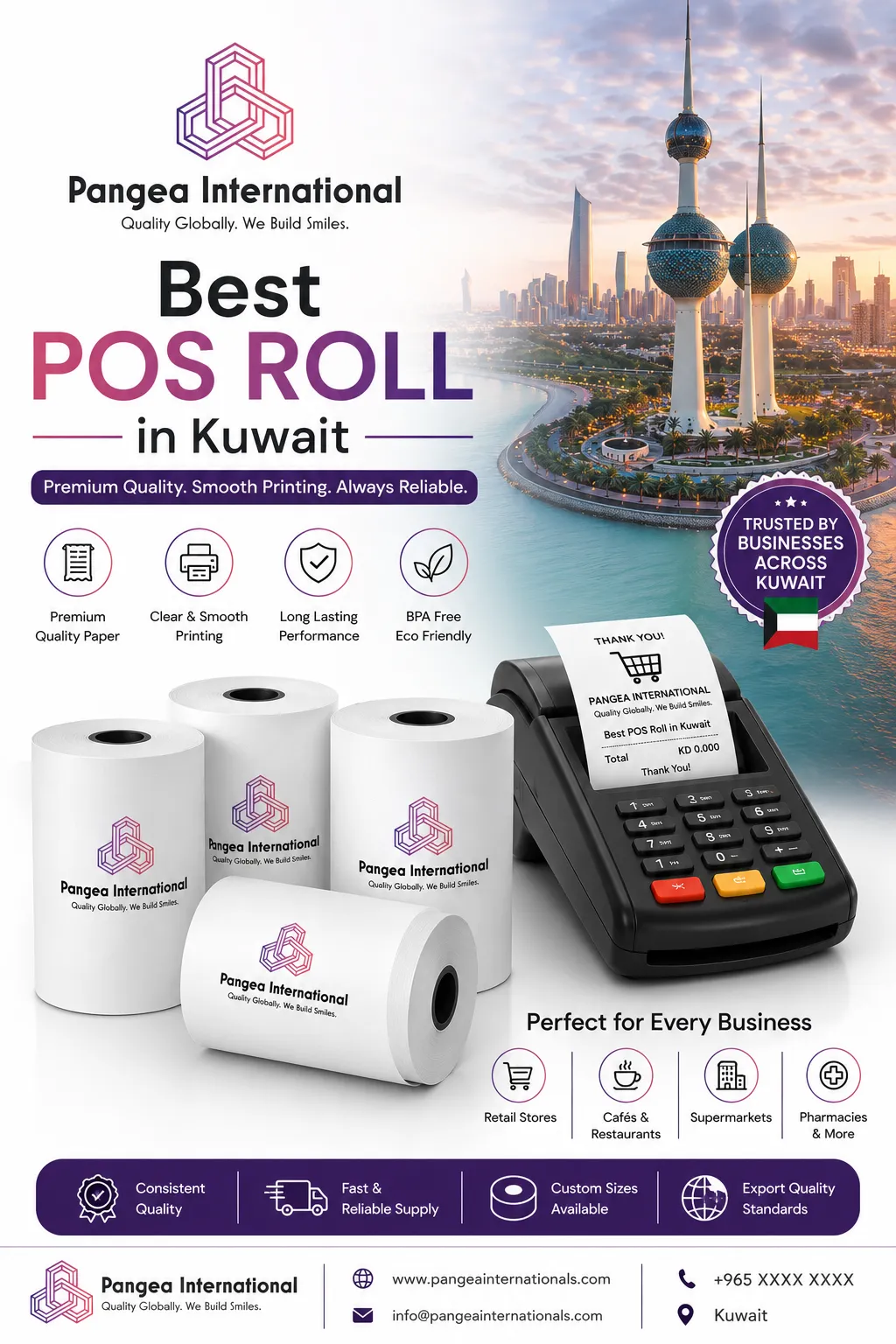
Walk into any baqala, restaurant, or supermarket in Kuwait City, Hawalli, or Salmiya, and you'll find the same small, easily overlooked item behind every single sale: a roll of thermal paper feeding through a receipt printer. Finding the best POS roll in Kuwait sounds like a simple task, until your printer jams during a busy Friday evening rush, or a customer's KNET receipt comes out faded and unreadable. Then it suddenly matters a great deal.
We are Pangea retails, a manufacturer and exporter of thermal paper products with an established presence across the USA, UK, UAE, Oman, Kuwait, and Qatar, and we've spent years helping retailers across the Gulf source paper that actually performs, not just paper that looks fine on a spec sheet. This guide brings together everything we've learned about what genuinely makes the best POS roll in Kuwait, from sizing and coating quality to how Kuwait's climate and payment ecosystem shape what "best" actually means here.
Maybe you're reading this because a printer jammed during a busy shift last week. Maybe you're setting up a new branch and want to get sourcing right from day one. Either way, what follows isn't a sales pitch dressed up as an article, it's the same walkthrough we'd give a customer on a call, written down so you can reference it whenever you need it.
By the end, you'll know exactly what to look for, what to avoid, and how to buy smart so your counter never goes quiet over something this preventable.
What Actually Makes a POS Roll "Best" for Kuwait's Market?
Here's a question worth asking yourself: best compared to what, exactly? A POS roll that performs beautifully in a mild, temperate climate can behave very differently once it's sitting in a stockroom in Kuwait during a 48-degree summer. So when we talk about the best POS roll in Kuwait, we're not just talking about a generic global standard, we're talking about paper engineered to hold up under genuinely demanding local conditions.
Three things define quality here: a coating that resists fading under extreme heat, a width and core size that matches the printers actually in use across Kuwaiti retail (dominated by 57mm and 80mm formats), and consistent supply so a business never runs short during Kuwait's busy retail seasons, including Ramadan and the National Day holidays, when footfall and transaction volume spike sharply.
Think of it like choosing tyres for a car in the Gulf versus a car in a cooler climate. The tyre itself might look identical on the shelf, but the compound needs to be engineered differently to handle sustained heat without degrading. Paper coating works the same way, even if it's rarely discussed that openly by suppliers selling into this market, and it's exactly the kind of detail that separates a genuinely good supplier from one simply repackaging a generic global product without adapting it for the conditions it will actually face once it lands in Kuwait.
Why Getting This Right Matters More Than You'd Think
Kuwait's retail and payments landscape has grown substantially in recent years, with KNET, the country's dominant local card network, processing the overwhelming majority of everyday in-store transactions. Every one of those KNET transactions typically prints a receipt, which means a huge and steady daily demand for reliable POS paper across every retail counter, restaurant, pharmacy, and service business in the country.
Here's what a poorly chosen roll actually costs a Kuwait-based business, beyond the price tag:
-
Lost sales time: A jammed printer during a busy shift means a staff member stops serving customers, and a queue builds behind the one person stuck fixing it.
-
Customer trust: A faded or unreadable KNET receipt looks unprofessional, and in a market where customers increasingly expect a smooth, modern checkout experience, that impression matters.
-
Wasted spend: Emergency purchases from whichever nearby shop has stock cost more per roll than a planned bulk order would have, sometimes considerably more once you add up a full year of reactive buying.
### The Hidden Cost of Cutting Corners
Choosing the cheapest, unverified paper is a bit like choosing the cheapest air conditioning unit for a Kuwait summer. It might run fine for a while, but when it fails, it fails at the worst possible moment, and the cost of that failure usually outweighs whatever you saved upfront.
We've spoken with Kuwait retailers who assumed all thermal rolls were interchangeable, only to discover months later that their printer's print head had worn out faster than expected because the paper coating was inconsistent and abrasive, batch after batch, an expensive lesson that a slightly higher-quality roll would have avoided entirely.
A replacement print head isn't a small expense either, and sourcing the part in Kuwait can mean waiting on an import or a specialist technician, turning what should have been a routine paper reorder into a multi-week operational headache. None of this shows up as a single line item on any invoice, which is exactly why it's so easy to overlook until the costs have quietly added up over a full year of inconsistent sourcing, often without anyone at the business ever connecting the dots back to a paper decision made months earlier.
POS Roll Sizes in Kuwait: 57mm vs 80mm vs Specialty Widths
Width is non-negotiable, and it's the single biggest factor separating a roll that works from one that simply won't fit your printer at all.
|
Width |
Typical Use in Kuwait |
Common Lengths |
|
57mm (2 1/4") |
Handheld card machines, KNET terminals, taxi and delivery apps |
50', 85', 200' |
|
80mm (3 1/8") |
Countertop billing printers, supermarkets, restaurants |
200', 230' |
|
110mm |
Specialty kitchen order printers, select banking terminals |
Varies by supplier |
The 57mm and 80mm formats between them cover the overwhelming majority of retail and hospitality printers across Kuwait, from a small baqala's handheld terminal to a large supermarket's countertop billing station. Before ordering in bulk, always check your printer's manual or simply measure your existing roll's width, core diameter, and outer roll size directly, since guessing is the fastest route to a box of stock that won't load correctly.
Pangea retails supplies both formats, along with jumbo rolls specifically manufactured for ATM applications, giving Kuwait businesses running a mixed printer fleet a single, reliable source rather than juggling multiple suppliers for different machine types.
Beyond the two dominant formats, some specialty applications in Kuwait, including certain banking terminals and kitchen order printers, call for less common widths like 110mm. If your business operates equipment outside the standard 57mm or 80mm range, it's worth confirming availability and lead times with your supplier early, since specialty widths sometimes require longer production planning than the two mainstream formats that most manufacturers keep in continuous stock.
KNET and POS Roll: What Kuwait's Payment Ecosystem Means for Your Paper
KNET isn't just Kuwait's dominant payment network, it's practically the default expectation at any retail counter, and understanding its role helps explain why paper quality matters so much here specifically. Nearly every KNET transaction generates a printed confirmation slip, whether the customer keeps it or not, which means your printer needs to perform reliably transaction after transaction throughout a full trading day.
Some suppliers in Kuwait even market rolls specifically as "KNET rolls," which typically just means a 57mm or 80mm roll suited to the compact card terminals used at most retail counters. The terminology varies by vendor, but the underlying specification requirements are the same ones covered throughout this guide: correct width, correct core size, and a coating that holds up under repeated daily use.
It's worth noting that KNET terminals, like most compact payment devices, tend to be relatively unforgiving of paper that doesn't match their exact specification. Unlike a large countertop printer with a bit more mechanical tolerance, a small handheld or fixed KNET terminal often has very little margin for a roll that's slightly too large in outer diameter or slightly off on core size. This is one more reason sample testing matters so much before committing to a bulk order, particularly if you're switching suppliers or trying a new specification for the first time.
GSM, Coating Quality, and Why Kuwait's Heat Changes the Calculation
GSM, or grams per square metre, tells you how thick the paper is, and it typically ranges from 48 GSM on lighter, economical stock to 70-80 GSM on heavier, premium rolls. In a temperate market, this choice mostly comes down to cost versus how long a receipt needs to stay legible.
In Kuwait, there's an additional factor worth weighing: extreme ambient heat accelerates the natural fading process built into thermal coating chemistry. A roll that performs perfectly in a Rajkot warehouse can behave quite differently after sitting in a poorly ventilated Kuwait stockroom through peak summer months. This is exactly why we manufacture our export-grade paper with fade-resistant coating formulated to hold up under sustained heat exposure, rather than simply repackaging a standard domestic-grade product for international markets.
Heavier GSM stock, generally in the 65-80 GSM range, tends to perform more consistently under these conditions, resisting both physical wear and premature fading better than lighter economy-grade paper. For businesses that need receipts to stay legible for warranty claims or accounting reconciliation weeks after printing, this is worth the marginal cost difference.
It's a similar logic to why heavier-duty packaging materials tend to outperform their lighter counterparts in demanding climates generally: the extra material cost is small relative to the reliability it buys you, and the cost of a failure, whether that's a faded receipt causing a customer dispute or a jam during peak trading hours, almost always outweighs whatever was saved by choosing the cheapest available grade. Businesses that have made the switch to heavier, heat-resistant stock consistently tell us they wish they'd done it sooner, once they see the actual difference in how consistently receipts print across a full trading day in summer conditions, particularly during the hottest stretch of the year when ambient stockroom temperatures can climb considerably higher than most businesses realise.
BPA-Free POS Roll: A Growing Priority Across Kuwait
Standard thermal coating has historically relied on Bisphenol A, or BPA, a chemical developer now restricted across the EU and several US states due to health concerns tied to repeated skin contact. Staff at retail counters, restaurants, and pharmacies across Kuwait handle receipts dozens or hundreds of times a day, and BPA-free paper reduces that cumulative exposure at essentially no meaningful cost difference.
For businesses supplying receipts to health-conscious customers, or those with procurement policies shaped by international parent companies or franchise agreements, BPA-free compliance is increasingly a baseline expectation rather than a nice-to-have. If your current supplier can't produce documentation on request, that's worth treating as a genuine red flag rather than a minor formality, especially given how much a hot climate can amplify even small inconsistencies in coating quality over time. Pangea retails manufactures its entire POS roll range as 100% BPA-free, with documentation available on request for institutional and corporate buyers across the Gulf.
How Does Thermal POS Roll Printing Actually Work?
It helps to understand the mechanics, because it explains almost every quality issue you'll ever run into with this product, especially in a hot climate.
Modern POS printers use thermal print heads, tiny heating elements that activate at precise points as paper feeds past. When the coated surface passes under the head, heat triggers a chemical reaction between a dye and a colour developer built into the coating, producing dark text exactly where needed. There's no ink cartridge, no ribbon, nothing beyond the paper feed mechanism itself, which is why thermal printing dominates retail counters everywhere from Kuwait City to London.
This is also why heat exposure before printing matters so much. If a roll has been sitting in a hot stockroom or a delivery vehicle for weeks, part of that coating can pre-react from ambient heat alone, producing faint grey patches even before the roll is ever loaded into a printer. It's a bit like film that's been partially exposed before the photo was ever taken; the damage is done before you even press the shutter.
Understanding this mechanism is exactly why we manufacture our export paper with a coating formulated to resist this kind of premature activation, rather than relying on standard domestic-grade stock that was never designed with Gulf storage conditions in mind, from the shipping container all the way through to a hot back-office stockroom months later.
Troubleshooting: Common POS Roll Problems in Kuwait's Climate
Let's work through this like a checklist, since most complaints we hear from Kuwait retailers fall into a handful of predictable categories, and diagnosing the right one saves considerable time compared to guessing.
Faint or patchy printing straight out of the box almost always traces back to heat exposure during storage or transit, rather than a printer fault. Before assuming your machine needs servicing, check whether the batch has been sitting somewhere hot, and try a fresh, properly stored roll for comparison.
Receipts fading within days rather than weeks typically means either a lower-grade coating than expected or poor storage conditions after delivery, particularly relevant during Kuwait's peak summer months when even a short stint in direct sunlight can noticeably accelerate fading.
Frequent jams despite correct width usually points to a core diameter or outer roll diameter mismatch, causing enough wobble to disrupt smooth feeding, especially over a long, busy shift.
Inconsistent quality between batches from the same supplier is worth raising directly rather than assuming it's normal. A reliable manufacturer should be able to explain what changed and correct it, not simply shrug it off as unavoidable variation.
If you manage multiple locations and start seeing the same issue crop up across several branches at once, that's a strong signal the problem lies with a specific batch or specification rather than individual machines, and it's worth addressing with your supplier directly rather than treating each location as a separate mystery to solve every time it comes up.
How Kuwait Compares to Other Gulf Markets We Supply
Having exported thermal paper across the USA, UK, UAE, Oman, Kuwait, and Qatar, we've noticed some genuinely useful patterns worth sharing, since Kuwait isn't identical to its neighbours even though the climate and general retail landscape look similar on the surface.
Compared to the UAE, Kuwait's retail sector is somewhat more concentrated around a smaller number of large chains alongside a dense network of independent baqalas, meaning bulk standardisation across a chain's locations often delivers a bigger relative cost saving than in more fragmented markets. Compared to Oman, Kuwait's summer heat is, if anything, slightly more extreme in peak months, reinforcing the same storage and coating-quality guidance covered throughout this article, just with less room for error.
One consistent thread across all these markets, Kuwait included, is that businesses sourcing directly from an established manufacturer rather than a string of resellers tend to report fewer quality complaints over time, simply because there are fewer opportunities for a product to sit in suboptimal storage conditions somewhere along a longer, more fragmented supply chain before it reaches the counter. This pattern holds regardless of which specific Gulf market a business operates in, which is exactly why we apply the same coating standards and quality checks across our entire regional export range rather than varying quality by destination.
How to Choose the Best POS Roll in Kuwait for Your Business
Let's make this practical. Here's the exact process worth working through before placing an order, whether you're setting up your very first counter or standardising paper across a growing chain of branches.
Match the width to your printer first. Check your printer's manual or measure your current roll directly. Width, core diameter, and maximum outer roll size all need to line up precisely.
Think about your daily transaction volume. A small baqala or salon printing under a hundred receipts a day is fine with a shorter, economical roll. A busy supermarket or restaurant chain burning through stock during peak hours needs longer rolls to avoid constant reloading.
Factor in Kuwait's climate. As covered above, heat-resistant coating and slightly heavier GSM tend to perform more reliably here than economy-grade stock designed for temperate markets.
Ask about BPA-free certification. It's a simple question that separates suppliers who take quality seriously from those who don't.
Request a sample before bulk ordering. A test roll run through your actual printer, in your actual environment, tells you more in a week than any specification sheet ever could.
Here's a quick checklist worth keeping on hand, printed out and stuck somewhere near your billing counter or shared with whoever handles procurement across your locations:
-
[ ] Confirm exact width against your printer's manual (57mm, 80mm, or specialty size)
-
[ ] Confirm core diameter and outer roll diameter both fit your machine
-
[ ] Decide on GSM based on transaction volume and how long receipts need to stay legible
-
[ ] Ask specifically about heat-resistant, export-grade coating
-
[ ] Confirm BPA-free certification and request documentation
-
[ ] Request a sample before committing to a bulk order
-
[ ] Confirm shipping timelines and minimum order quantities for Kuwait delivery
Real-World Examples: Who's Actually Buying POS Roll Across Kuwait
It helps to see how different Kuwait businesses use this product day to day, because the right specification genuinely depends on context.
-
Supermarkets and hypermarkets: High transaction volume, detailed itemised bills, typically running 80mm rolls on countertop printers across multiple checkout lanes.
-
Restaurants and cafes: Both a customer-facing receipt and, often, a separate kitchen order ticket printer, usually running the same paper category across both stations.
-
Baqalas and small retail shops: Compact counters where a narrow, economical 57mm roll keeps both the printer and the paper budget manageable.
-
Pharmacies: Prescription slips and billing receipts where legibility over several weeks genuinely matters, pushing toward heavier GSM stock.
-
Salons and service businesses: Handheld or compact billing setups favouring the smaller, more economical roll format.
-
Delivery and logistics: Riders and drivers carrying portable printers rely on the compact 57mm format that fits easily in a bag or vehicle.
Each of these businesses is solving a slightly different problem, but all of them share the same underlying requirement: dependable paper that fits, prints clearly, and doesn't run short at the worst possible moment.
It's worth noticing something else in that list too: the businesses with the highest transaction volumes, supermarkets, busy restaurants, delivery operations, are also the ones with the least tolerance for downtime. If you're running a low-volume boutique printing a handful of receipts a day, an occasional jam is a minor annoyance. If you're running a supermarket checkout lane during peak evening hours, the same jam becomes a genuine operational problem with a visibly frustrated queue to show for it. Match how seriously you treat this sourcing decision to your actual transaction volume, and you'll rarely go wrong.
Case Study: A Kuwait City Retail Chain's POS Roll Standardisation
A multi-branch retail chain operating across Kuwait City and Hawalli came to us with a familiar complaint: inconsistent paper quality between branches, occasional printer jams, and rising costs from scattered small purchases made whenever a local branch ran short.
Each store had been sourcing independently, with no standardisation on GSM, width, or coating quality across the chain's printer fleet. Some branches were buying whatever was locally available at short notice, without much attention to whether it matched the coating specification other stores were using.
We worked with the chain to standardise on a single specification, an 80mm heat-resistant, BPA-free roll for countertop printers, sourced centrally and shipped in bulk rather than through scattered local purchases. Within two months, printer-related complaints dropped noticeably, and because orders were now consolidated into a single scheduled shipment rather than fragmented local buys, the chain's per-unit cost fell by roughly 15%.
The operations manager told us the bigger win wasn't even the cost savings, it was that staff stopped worrying about paper quality altogether and could focus on actually running the counter, which is really the point of getting this decision right in the first place.
Six months on, the chain reported something we hear often once businesses make this switch: nobody could quite remember the last time a printer jammed during a busy shift. That's not a dramatic headline result, but it's exactly the kind of quiet, unremarkable reliability that a well-chosen consumable is supposed to deliver, and it freed up enough staff time across the chain's branches that management started using the same standardisation approach for other recurring supply categories too.
Advanced Tips for Sourcing POS Roll in Kuwait
### Storage in a Desert Climate
Heat, humidity swings, and direct sunlight are the enemies of thermal paper anywhere, but they matter even more in Kuwait's climate. Store stock away from windows, direct sunlight, and any heat-generating equipment, ideally in a cool, ventilated storeroom rather than a hot back office or a shipping container left standing in direct sun.
### Bulk Buying and Import Planning
Consolidating purchases into a single scheduled bulk order, rather than frequent small reactive purchases, typically reduces per-unit cost by somewhere in the range of 12-18%, based on what we've seen across Gulf retailers who make this switch. For Kuwait-based buyers sourcing from an overseas manufacturer, planning shipments around predictable reorder cycles also helps smooth out lead times, which matter more when goods are travelling by sea freight rather than a same-day local delivery.
A practical approach many of our Kuwait customers use is forecasting roughly two to three months of stock ahead, rather than ordering reactively as supplies run low. This buffer accommodates the realistic transit time for sea freight from Rajkot, while still keeping working capital tied up in inventory reasonably efficient. Businesses managing multiple branches often find it useful to centralise ordering through a single point of contact, both to simplify the relationship with the manufacturer and to make it easier to spot patterns in consumption across locations over time.
### A Note on Kuwait's Tax Environment
As of 2026, Kuwait has not implemented VAT, unlike several other GCC states that introduced it in recent years, which keeps landed costs on imported paper products comparatively straightforward for now. That said, Kuwait's fiscal policy has been under gradual review, with government plans currently ruling out VAT before 2028 while alternative measures like selective excise taxes remain under discussion. Businesses planning long-term supply contracts should keep an eye on any future changes to import duties or tax treatment and build reasonable flexibility into supplier agreements, rather than assuming the current tax environment will remain unchanged indefinitely.
Common Mistakes When Buying POS Roll in Kuwait
Assuming any thermal roll will do. Width, core size, and coating quality all need to match your specific printer and your storage environment, not just a generic "thermal paper" label.
Ignoring climate-specific coating quality. As covered above, paper designed for temperate markets doesn't always perform the same way once it's been sitting in Kuwait's summer heat for weeks.
Buying reactively instead of on a schedule. Emergency local purchases cost more per unit and increase the odds of inconsistent quality across your fleet.
Not asking about BPA-free certification. An increasingly relevant question, and one a serious supplier should be able to answer immediately with documentation.
Skipping the sample test. A short trial run in your actual printer beats trusting a specification sheet every time, especially when sourcing from an overseas manufacturer for the first time.
Not planning around seasonal demand spikes. Transaction volumes across Kuwait's retail sector rise noticeably during Ramadan, Eid, and the National Day holidays. Businesses that don't build this into their reorder planning sometimes find themselves scrambling for stock precisely when demand across the whole market is highest and lead times are longest.
Signs Your Current Supplier Isn't Serving You Well
Not sure whether it's worth exploring alternatives? A few honest questions can clarify things quickly, and it's worth working through them periodically even with a supplier you've used for years, rather than only reconsidering the relationship after something has already gone wrong.
Does your supplier struggle to answer basic questions about GSM, coating chemistry, or BPA-free status without hesitation? A vague "yes, it's good quality" isn't the same as an actual specification sheet or test documentation, and a supplier who can't produce one shouldn't be treated as a reliable long-term source.
Have you noticed quality drifting between batches, even though you're ordering the same nominal specification each time? This is one of the more frustrating patterns in this category, since it often goes unnoticed until a customer complains about a faded receipt or a technician flags an unusually high jam rate.
Does reordering feel more complicated than it should, with unclear pricing, inconsistent lead times, or a supplier who seems surprised every time you place a bulk order rather than treating it as routine? A supplier who's genuinely set up to serve your business makes this part of your operation boring, in the best possible sense.
Finally, does your supplier understand Kuwait's climate and storage challenges specifically, or are they simply repackaging a generic product without any real consideration for how it performs once it reaches your stockroom? This distinction matters more than most buyers realise until they've experienced the difference firsthand.
Local Sourcing vs Importing: Why Manufacturer-Direct Often Wins
Kuwait businesses generally have two paths for sourcing POS roll: buying from a local distributor who imports and resells, or working directly with an overseas manufacturer. Both have a place, but it's worth understanding the trade-offs.
Local distributors offer convenience and fast, often same-day, local delivery, which suits businesses needing small, urgent top-ups. The trade-off is typically a higher per-unit price, since you're paying for a middleman's margin on top of the manufacturer's cost, and less visibility into the actual coating specification and quality control behind what you're buying.
Sourcing directly from an established manufacturer like Pangea retails, with an existing export presence across the USA, UK, UAE, Oman, Kuwait, and Qatar, means clearer answers about coating chemistry, consistent quality across every shipment, and pricing that improves meaningfully as your order volume grows. It requires planning further ahead for shipping and customs clearance, but for businesses with predictable, recurring demand, the cost and quality benefits typically outweigh the extra lead time.
A sensible middle ground many Kuwait businesses land on: source a scheduled bulk supply directly from a manufacturer for planned, predictable demand, while keeping a small local backup source for genuine emergencies. This balances cost efficiency with the operational safety net of a nearby fallback option, giving you the best of both approaches without over-relying on either one exclusively.
Environmental Considerations for Kuwait Businesses
Sustainability is becoming a more visible purchasing factor across the Gulf's retail sector, not just a marketing checkbox on a product page. Standard thermal-coated paper is genuinely difficult to recycle through conventional paper streams because of its chemical coating, a challenge shared across every market we export to, Kuwait included.
Choosing a well-manufactured, consistent roll indirectly reduces waste, since fewer misprints and reprints occur compared to inconsistent, budget-grade stock that fades or jams partway through a busy shift. Some larger Kuwait retail groups, particularly those with international parent companies or GCC-wide sustainability commitments, have started asking suppliers directly about base paper sourcing and coating chemistry as part of their standard vendor evaluation process, treating it as one measurable line item within a broader environmental reporting framework.
For businesses balancing sustainability goals against the operational necessity of printed receipts, working with a manufacturer who can speak honestly about sourcing and coating practices offers a sensible middle ground between ignoring the question entirely and demanding certifications that aren't yet standard practice across the regional supply chain. Even small, incremental steps in this direction tend to matter more over time than businesses initially expect, particularly as customer and partner expectations around sustainability continue to shift across the Gulf region.
Building a Reliable Long-Term Supply Relationship
There's a meaningful difference between finding a one-time supplier for a single order and building a relationship that actually supports your business as it grows across Kuwait or expands into neighbouring Gulf markets. The retailers who get the most value from their paper sourcing tend to treat it less like a series of transactions and more like an ongoing operational partnership.
What does that look like in practice? It means a supplier who remembers your specifications without needing them re-explained every time you place an order. It means proactive communication about potential shipping delays before they become your emergency, rather than a surprise discovered only when stock runs out. It means a degree of flexibility during unusually busy periods, like Ramadan or the National Day holidays, when transaction volumes across Kuwait's retail sector spike noticeably above baseline.
It also means honesty about lead times. A supplier who overpromises delivery timelines just to win an order, only to fall short when you genuinely need stock, costs you far more in operational disruption than any short-term pricing advantage was ever worth. When evaluating a new supplier, ask directly about typical lead times from Rajkot to Kuwait, their capacity to handle sudden bulk orders, and how they've managed past shipping disruptions. Their answers tell you a great deal about whether you're dealing with a transactional vendor or a genuine long-term partner.
A Buyer's Quick-Reference Glossary
If you're new to sourcing this category of paper, a few terms come up repeatedly in supplier conversations that are worth understanding before you're on a call trying to place your first order. Getting comfortable with this vocabulary early saves considerable back-and-forth once you're actually negotiating specifications and pricing with a potential supplier.
-
Direct thermal: The printing technology used by virtually all modern POS printers, where heat directly activates the coating without any ribbon or ink cartridge involved.
-
GSM: Grams per square metre, the standard measure of paper weight and thickness, directly tied to durability and print darkness.
-
Core diameter: The size of the cardboard or plastic tube at the centre of the roll, which must match your printer's spindle exactly.
-
Coated side: The side of the paper treated with the heat-reactive layer, which must face the printer head correctly to produce legible text.
-
Fade resistance: How well printed text holds up against heat, light, and time, a particularly important spec for hot-climate markets like Kuwait.
-
BPA-free: Coating manufactured without Bisphenol A, an increasingly standard expectation for institutional and health-conscious buyers.
-
FOB / CIF: Common international shipping terms determining who bears responsibility for freight costs and risk at different points in the shipping process, relevant when importing directly from an overseas manufacturer.
Walking into a supplier conversation already familiar with these terms tends to produce faster, more precise quotes, since you can specify exactly what you need rather than relying on the supplier to guess based on a vague description of your business.
Where to Buy the Best POS Roll in Kuwait: Why Pangea retails
Pangea retails manufactures 100% BPA-free thermal paper rolls in the widths and lengths covered throughout this guide, including 2 1/4" and 3 1/8" formats, along with jumbo rolls for ATM applications, backed by an established export track record across the USA, UK, UAE, Oman, Kuwait, and Qatar.
Sourcing directly from a manufacturer rather than a reseller several steps removed from production means clearer answers about coating chemistry and heat resistance, consistent quality across every shipment, and pricing that improves as your order volume grows. If you're ready to standardise your supply or simply want a sample before committing to a bulk order, our export team can match the right specification to your business and arrange shipping to Kuwait.
Explore our full POS Rolls range or get in touch through our contact page to discuss volumes, specifications, and shipping timelines for your business.
Frequently Asked Questions About POS Roll in Kuwait
What size POS roll do most Kuwait businesses need?
The vast majority of retail and hospitality printers across Kuwait use either 57mm or 80mm width rolls, and checking your specific printer's manual is the fastest way to confirm which one you need.
Does Kuwait's climate actually affect thermal paper quality?
Yes, sustained high heat accelerates the natural fading process in standard thermal coating, which is why heat-resistant, export-grade paper tends to perform more reliably in Kuwait than economy-grade stock designed for temperate markets.
Is BPA-free POS roll widely available in Kuwait?
Yes, and demand for it is growing, with Pangea retails supplying 100% BPA-free thermal rolls as standard across its entire export range to Kuwait and the wider Gulf region.
Is it better to buy POS roll locally in Kuwait or import directly from a manufacturer?
Local distributors offer convenience for urgent small orders, while sourcing directly from an established manufacturer typically offers better pricing and more consistent quality for planned, recurring bulk demand.
Does Kuwait charge VAT on imported POS roll purchases?
As of 2026, Kuwait has not implemented VAT, unlike several neighbouring GCC states, though businesses should stay aware that this could change as fiscal policy continues to evolve.
Conclusion: Get Your POS Roll Right, and Kuwait's Heat Stops Being a Problem
At the end of the day, finding the best POS roll in Kuwait comes down to matching a handful of specifications, width, core size, GSM, and heat-resistant coating, to how your business actually operates in this specific climate and market, rather than simply defaulting to whatever's cheapest or most convenient locally.
We know that's an unusual thing to promise in a buying guide, that success looks like thinking about this less, not more, but that's genuinely the outcome worth aiming for. The retailers who handle this well aren't the ones with the most complicated sourcing strategy; they're the ones who solved it once, properly, and moved on to running the rest of their business without this particular headache resurfacing every few months.
Pangea retails has built its export-grade POS roll supply around exactly these fundamentals, so Kuwait businesses can order with confidence rather than trial and error. If you're ready to source the best POS roll in Kuwait for your business, or simply want a sample before committing to a bulk order, our export team is ready to help. Reach out today, and let's keep your counter running smoothly, no matter how hot it gets outside.