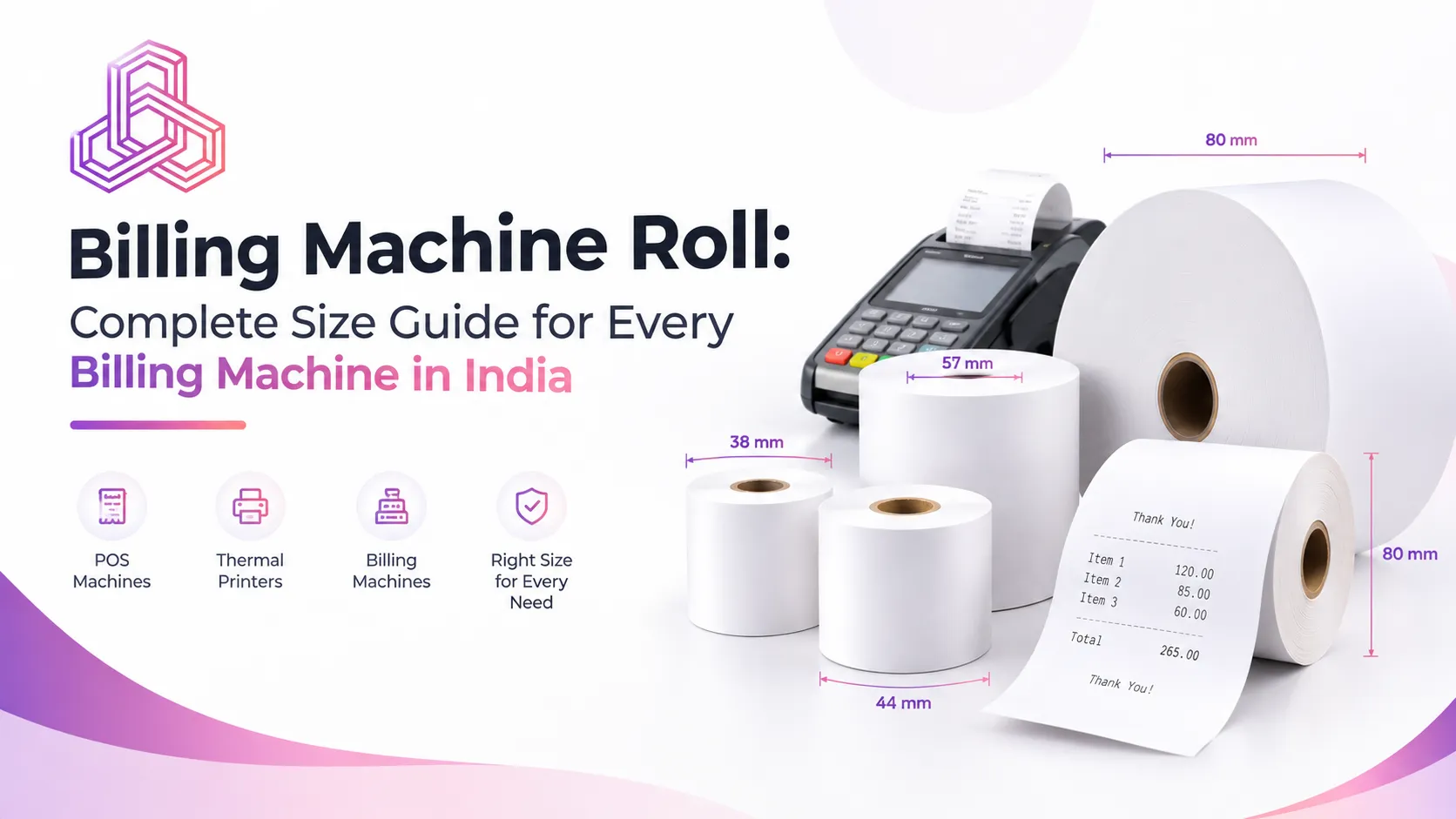
Open the paper compartment of any billing machine in India and you’ll find a roll of thermal paper that looks almost identical to every other roll on the market - until you actually try to fit the wrong one in. A POS machine roll that’s even a couple of millimetres off in width or diameter will jam a printer, waste paper, and bring a busy counter to a stop at the worst possible moment. Yet most people buying this product have no idea their exact machine’s specification, and end up guessing, or trusting whatever a local shop happens to have in stock.
This guide exists to fix that. Below is a complete, practical size reference for every major category of cash register roll used across India - POS terminals, EDC card machines, kitchen printers, cash registers, and weighing-scale printers - along with a brand-by-brand lookup table, a GSM guide, and clear step-by-step instructions for measuring your own machine if you’re not sure which size you actually need.
Quick Answer: What Is a Billing Machine Roll?
A thermal billing roll is a roll of heat-sensitive thermal paper used inside a billing machine, POS terminal, or cash register to print customer receipts, GST invoices, and transaction records without ink or toner. The printer’s thermal print head heats specific points on the paper’s coated surface, and those points darken to form text and numbers. Every billing machine roll is defined by three measurements that matter for compatibility: width, outer diameter (which determines roll length), and core diameter - get any one of these wrong and the roll either won’t fit the machine or will jam during printing.
Why Getting Billing Machine Roll Size Right Actually Matters
A Few Millimetres Is the Difference Between Fitting and Jamming
Billing machines are built with a specific paper compartment size, and a billing paper roll that’s too wide simply won’t close the compartment lid, while one that’s too narrow will feed unevenly and jam within the first few prints. Diameter matters just as much - a roll with too large an outer diameter physically won’t fit inside the compartment at all, no matter how correct the width happens to be.
The Cost of Guessing
Buying the wrong receipt roll size isn’t just an inconvenience - it means wasted money on stock that can’t be used, a scramble to find the right size during business hours, and in the worst case, a print head damaged by forcing an ill-fitting roll into the mechanism. Getting the specification right once, and buying the correct billing machine roll in bulk afterward, avoids all of this.
The Master Billing Machine Roll Size Chart
By Machine Type
|
Machine Type |
Common Width |
Common Length |
Core Diameter |
Typical Use |
|---|---|---|---|---|
|
Desktop POS/billing printer |
79mm-80mm |
40m-80m |
12mm-18mm |
Retail counters, restaurants, general billing |
|
EDC / card swipe terminal |
57mm-58mm |
15m-25m |
8mm-12mm |
Card payment terminals, mobile POS |
|
Kitchen order printer (KOT) |
76mm-80mm |
60m-80m |
12mm |
Restaurant kitchen tickets |
|
Cash register (ECR) |
57mm or 76mm |
20m-40m |
12mm |
Older-style electronic cash registers |
|
Weighing scale printer |
40mm-58mm (often adhesive) |
Varies by label count |
25mm-40mm |
Supermarkets, sweet shops, grocery counters |
|
ATM / self-service kiosk |
80mm |
60m-80m |
17mm-18mm |
Banking and self-checkout terminals |
This table covers the vast majority of billing setups across India, but always double-check against your specific machine model, since manufacturers occasionally use non-standard dimensions even within the same general category of hardware.
Understanding the Three Numbers on Every Billing Machine Roll Listing
A swipe machine roll is usually listed as three numbers, like “79mm x 50m x 12mm” - the first is width, the second is the roll’s total paper length, and the third is the core diameter (the hollow tube the paper is wound around). All three need to match your machine, though width and core diameter matter most for basic fit, while length affects how often you need to replace the roll.
Billing Machine Roll Size by Brand: A Practical Lookup Table
India’s billing and POS hardware market includes several major brands, and while there’s real overlap, this table gives a starting point for identifying the right POS machine roll without opening the compartment and measuring first.
|
Brand / Ecosystem |
Common Roll Size |
Notes |
|---|---|---|
|
Pine Labs terminals |
57mm x 25m |
Standard across most Pine Labs EDC models |
|
WeP billing printers |
79mm-80mm x 50m-70m |
Popular for retail billing across India |
|
TVS thermal printers |
79mm-80mm x 50m |
Widely used with Tally-integrated billing setups |
|
Epson TM series printers |
79mm-80mm or 57mm (model-dependent) |
Check specific TM model number before ordering |
|
Bank-issued EDC machines (various) |
57mm x 15m-25m |
Most bank card terminals use this compact size |
|
Petpooja/restaurant POS-integrated printers |
79mm-80mm x 60m-80m |
Higher length for kitchen order ticket volume |
|
Posiflex and similar POS systems |
79mm-80mm x 50m-80m |
Standard retail billing counter size |
|
Older ECR-style cash registers |
57mm or 76mm x 20m-30m |
Varies significantly by model age and make |
If your specific brand or model isn’t listed here, the measuring method below will get you an exact answer in under five minutes, without needing to contact the manufacturer or dig through old paperwork.
How to Measure Your Own Billing Machine Roll Size
Step 1: Measure the Width
Remove an existing roll (or the compartment itself if empty) and measure the paper’s width edge to edge in millimetres. Most billing machines in India use either 57mm, 58mm, 79mm, or 80mm - if your measurement falls close to one of these, that’s almost certainly your correct width.
Step 2: Measure the Core Diameter
The core is the cardboard or plastic tube at the centre of the roll. Measure its inner diameter, since this determines whether a new roll’s core will sit correctly on your machine’s holder spindle. Common core sizes are 12mm, 17mm, 18mm, and 25mm.
Step 3: Check the Compartment’s Maximum Diameter
Measure the maximum outer diameter the paper compartment can physically accommodate. This determines the longest roll length you can use - a longer roll means fewer replacements, but only if it actually fits.
Step 4: Cross-Check Against the Machine’s Manual or Model Number
If you still have your billing machine’s user manual or box, the exact cash register roll specification is usually printed there under “consumables” or “paper specifications.” A quick search of the model number online often surfaces this even years after purchase.
GSM Guide for Billing Machine Roll Buyers
What GSM Actually Means for a Billing Machine Roll
GSM (grams per square metre) measures the paper’s weight and thickness, which directly affects print durability and how long a printed receipt stays legible. A higher GSM thermal billing roll generally means better print quality and longer-lasting records, at a marginally higher cost per roll.
|
GSM |
Quality Level |
Best Use Case |
|---|---|---|
|
48-55 GSM |
Economy, not recommended |
Avoid for GST-compliant billing |
|
60 GSM |
Basic |
Low-footfall, non-compliance-critical use |
|
65 GSM |
Standard, most common |
General retail, restaurant, and EDC billing |
|
80 GSM |
Premium, archival |
GST record-keeping, high-value transactions, long-term document retention |
Why GSM Matters for GST Compliance
Under GST rules, businesses need to retain transaction records for several years, and a low-GSM billing paper roll printed on economy paper can fade within months, creating a genuine compliance gap at audit time. Choosing at least 65 GSM as a baseline, and 80 GSM for high-value or long-retention needs, avoids this problem entirely.
BPA-Free Billing Machine Roll: What to Know
The Chemistry Behind Thermal Paper
Most thermal paper, including the majority of receipt roll stock sold in India, is coated with a colour-developing chemical, and in much of the market that chemical is Bisphenol A (BPA) - linked to hormonal disruption through repeated skin contact. Cashiers, delivery staff, and anyone handling receipts throughout a shift are exposed to this repeatedly.
Who Should Prioritise BPA-Free Rolls
Food service businesses, pharmacies, and any counter where staff handle both product and freshly printed receipts in immediate succession have the strongest case for switching their swipe machine roll supply to a certified BPA-free formulation. The EU banned BPA in thermal paper in 2020, and India’s regulatory direction is moving the same way.
Checking for Genuine BPA-Free Certification
Many sellers advertise “BPA-free” without backing it up, so ask for the specific certification or lab test behind the claim before trusting it. A genuinely BPA-free POS machine roll typically costs only a small premium over standard stock at bulk pricing.
Common Billing Machine Roll Sizing Mistakes to Avoid
-
Ordering by width alone and ignoring core diameter: a roll can be the right width and still fail to sit properly on the spindle if the core doesn’t match.
-
Assuming all EDC machines use the same size: while 57mm is common, some card terminals use 58mm, which is close enough to cause a loose, unreliable fit rather than an outright mismatch.
-
Buying the longest roll available without checking maximum compartment diameter: a longer roll simply won’t close the compartment if its outer diameter exceeds what the machine can hold.
-
Switching suppliers without re-verifying the size: even the same nominal size (e.g., “80mm”) can vary slightly between manufacturers, so always sample-test a new supplier’s cash register roll before a full bulk order.
Bulk Buying: Billing Machine Roll Pricing in India
Businesses buying their thermal billing roll stock one small pack at a time from a local shop typically pay ₹15-28 per roll. Switching to direct bulk ordering from a manufacturer typically brings that down to the ₹6-12 per roll range, a saving that compounds quickly for any business printing dozens or hundreds of receipts a day.
|
Order Quantity |
Local Market Price/Roll |
Bulk Factory-Direct Price/Roll |
|---|---|---|
|
1-25 rolls |
₹18-28 |
Not typically available at this size |
|
25-100 rolls |
₹14-18 |
₹9-12 |
|
100-300 rolls |
₹12-15 |
₹7-9 |
|
300+ rolls |
₹10-13 |
₹6-8 |
GST Compliance and the Billing Machine Roll
Since GST rules require transaction records to remain accessible for several years, the billing paper roll your business uses is quietly a compliance document, not just a receipt. Beyond paper quality, confirm your supplier issues a proper GST-compliant invoice with correct HSN codes - that invoice is what lets a GST-registered business claim Input Tax Credit (ITC) on its own paper purchases, a benefit many informal local vendors can’t provide correctly.
Case Study: A Retail Chain Standardises Its Billing Machine Roll Across 15 Outlets
A retail chain running 15 outlets across different cities was sourcing its receipt roll stock independently at each location, resulting in three slightly different sizes in use depending on which local vendor each store manager happened to buy from. This created recurring printer jams and inconsistent receipt quality, along with inconsistent GST invoicing that complicated the chain’s centralised accounting.
After auditing every outlet’s actual machine specifications and standardising on a single verified billing machine roll size and GSM across the entire chain, printer jams dropped to near zero, and centralised bulk ordering cut the chain’s annual paper spend by roughly 38%. The lesson for any multi-location business: a size mismatch at even a few outlets creates costs that standardisation solves permanently.
Why Pangea Retails for Your Billing Machine Roll Supply
Pangea Retails manufactures thermal paper rolls in every standard Indian billing machine roll size, plus custom widths and lengths for less common machine models, with verified GSM, exact-dimension guarantees, a certified BPA-free range, and proper GST-compliant invoicing on every order.
For general buying guidance beyond sizing, see Pangea’s Billing Machine Roll: Complete Buying Guide, and for a deeper look at coatings and paper types, read the thermal receipt paper roll types and sizes guide. Businesses buying in true bulk should review POS roll wholesale pricing in India and the POS roll manufacturer buyers guide, and anyone weighing BPA-free options should read why BPA-free thermal paper matters.
Always Test a Sample Before Placing a Bulk Order
No business should commit to a large bulk order of any billing machine roll sight-unseen, however precisely the size matches on paper. A credible manufacturer will happily send a small sample batch to test in your actual machine before you commit to a bulk contract.
During a sample run, check three things: does the roll feed without jamming across a normal day of use, does the print stay dark and legible after several days, and does the roll’s measured width and core diameter exactly match what was quoted. A supplier who resists sampling, or ships different stock for the bulk order than what was sampled, is worth treating with real caution.
How to Calculate Your Monthly Billing Machine Roll Requirement
Businesses frequently either over-order or under-order their billing machine roll supply because they’ve never calculated real consumption against actual transaction volume.
Formula: (Average daily transactions × average receipt length in cm) ÷ roll length in cm, plus a 15-20% buffer for busy days and testing.
Worked example: A retail counter processing 150 bills a day, each averaging 15cm, using a 50-metre roll: 150 × 15cm = 2,250cm per day ÷ 5,000cm per roll = 0.45 rolls/day → roughly 14 rolls a month. Running this calculation per machine gives any business a realistic, defensible bulk order quantity instead of a rough guess.
Storage Tips to Protect Your Billing Machine Roll Investment
A billing machine roll stored badly loses print life fast, regardless of how correctly sized it was to begin with.
-
Keep unopened rolls away from direct heat sources like ovens, fryers, and direct sunlight.
-
Store in a dry area; humidity above 85% accelerates thermal-coating degradation and shortens receipt legibility.
-
Rotate stock FIFO (first in, first out) so no roll sits unused for months near a heat source.
-
Keep different sizes clearly labelled and separated if your business runs multiple machine types, to avoid an accidental mismatch at a busy counter.
Sustainability Considerations for Billing Machine Roll Buyers
Businesses increasingly weigh the environmental footprint of everyday consumables like billing paper alongside cost and compatibility. A quality billing machine roll can combine BPA-free chemistry with responsibly sourced base paper, and right-sizing your order using the consumption formula above avoids the waste that comes from over-ordering stock that sits unused. Some businesses are also exploring digital receipt options to reduce paper use, though a physical billing machine roll remains a practical necessity for most GST-compliant billing counters in India today.
Billing Machine Roll Sizes by Industry: What Different Businesses Actually Need
Retail Stores and Supermarkets
Retail counters and supermarket checkout lanes overwhelmingly use the 79mm-80mm width billing machine roll, since this size comfortably fits multi-item bills without running unnecessarily long. High-footfall supermarkets running multiple checkout lanes should standardise this same size and GSM across every counter to simplify restocking and avoid a mismatch during a busy shift.
Restaurants and Cafes
Restaurants typically run two separate printing points - a billing counter using the standard 79mm-80mm width, and a kitchen order printer that often uses the same width but a longer roll length to handle continuous KOT printing through service hours. Getting both printers standardised on the same core diameter, even if lengths differ, simplifies bulk ordering considerably.
Pharmacies and Medical Stores
Pharmacies typically use a standard 79mm-80mm thermal billing roll, but have a stronger case than most retail categories for prioritising BPA-free stock, since staff handle both medication and freshly printed receipts throughout the day, often without changing gloves between every transaction.
Petrol Pumps and Fuel Stations
Fuel stations generally use a narrower cash register roll, often in the 57mm range for card payment terminals alongside a standard billing printer for the fuel transaction receipt itself, meaning most fuel retailers need to stock two separate sizes rather than one.
Logistics and Courier Services
Courier and logistics businesses printing shipping labels and delivery documentation sometimes use non-standard widths depending on their labelling software and printer hardware, making the manual measurement method in this guide particularly useful for this category, since a generic size chart may not apply directly.
Billing Machine Roll Compatibility Across Popular Indian Billing Software
Many Indian businesses run their hardware through billing or accounting software like Tally, Marg ERP, Busy, or dedicated restaurant POS platforms, and the printer connected to that software determines the actual billing machine roll size needed - not the software itself. Tally-integrated setups, for instance, commonly connect to TVS or Epson thermal printers using the standard 79mm-80mm width, while Marg ERP retail setups follow the same general pattern.
The practical implication is straightforward: don’t search for “Tally billing roll size” or “Marg billing roll size” expecting a software-specific answer - instead, identify the actual printer hardware connected to your software, since that hardware, not the software brand, determines your correct billing paper roll specification. This is a common point of confusion for businesses newer to GST-compliant digital billing, and one worth clarifying directly here rather than leaving to guesswork.
Why Custom Billing Machine Roll Sizes Exist and When You Need One
While the vast majority of Indian billing setups use one of the standard sizes covered in this guide, a small number of specialised machines - certain older cash registers, imported POS hardware, or purpose-built printers for parking systems, token counters, and industrial weighing scales - use non-standard widths or core diameters that don’t match any common size.
If your measurements from the steps above don’t match 57mm, 58mm, 79mm, or 80mm width, or a standard 12mm, 17mm, 18mm, or 25mm core diameter, you likely need a custom order. A manufacturer capable of producing custom widths and core sizes, rather than only stocking the handful of standard dimensions, is essential for this situation - generic retail sellers typically can’t help, but a direct manufacturer usually can accommodate a custom specification at a modest minimum order quantity.
Environmental and Handling Factors That Affect Billing Machine Roll Performance
Temperature Sensitivity
Thermal paper is, by definition, sensitive to heat - which means a billing machine roll stored near a kitchen fryer, direct sunlight through a shop window, or inside a hot vehicle can develop faint pre-printed marks or degraded print quality before it’s even loaded into a machine. This is a particularly common issue for restaurant kitchen printer rolls stored too close to cooking equipment.
Humidity and Coastal Climates
Businesses in coastal or high-humidity regions of India should pay particular attention to storage conditions, since moisture accelerates the breakdown of the thermal coating that makes a swipe machine roll print in the first place. Rolls stored in a humid back room for extended periods often show reduced print darkness and shortened receipt legibility even when the paper itself looks undamaged.
Handling During Loading
Improper loading - inserting a roll backwards, forcing it against the print head, or failing to seat the core correctly on the holder spindle - causes many of the “printer problems” that actually trace back to handling rather than the billing machine roll itself. A brief staff training note covering correct loading direction prevents a surprising share of avoidable service calls.
Troubleshooting: When the Right Size Still Doesn’t Solve Printer Jams
Occasionally a business measures correctly, orders the right size, and still experiences jams - a frustrating situation that usually points to one of a few less obvious causes. A worn print head roller, a misaligned paper sensor, or a build-up of paper dust inside the mechanism can all cause jamming even with a perfectly matched thermal billing roll. Before assuming the paper is at fault a second time, it’s worth having the machine itself inspected, since continuing to blame the paper can mean an underlying hardware issue goes unaddressed indefinitely.
A quick way to isolate the cause is testing a small sample from a different, known-reliable supplier in the same machine. If jams continue even with a verified correct-size cash register roll from a trusted source, the printer itself likely needs servicing rather than another change of paper.
Building a Standing Reorder System for Billing Machine Roll Stock
Many of the sizing and stockout problems covered in this guide trace back to the same root cause: treating billing paper roll purchasing as a reactive task rather than a planned one. Businesses that build a simple standing reorder system - a fixed monthly or quarterly order based on the consumption formula above, placed with a verified supplier before stock actually runs out - largely eliminate both the sizing confusion and the last-minute local purchases that tend to be more expensive and less reliable.
For multi-location businesses specifically, a centralised reorder system also solves the standardisation problem highlighted in the case study earlier in this guide. When every outlet orders independently, size and GSM drift apart over time as different managers make different local purchasing decisions. A single, centrally managed receipt roll ordering process keeps every location on the same verified specification without relying on each site to make the right call individually.
A Final Word on Getting This Right the First Time
Sizing a thermal billing roll correctly is a genuinely small technical task - three measurements and a lookup table - but the businesses that skip it pay for that shortcut repeatedly, in printer jams, wasted paper, and the time spent troubleshooting a problem that a five-minute measurement would have prevented from the very start. Whether you’re setting up a single new billing counter or auditing paper supply across an established multi-outlet business, the process in this guide applies the same way: measure once, verify against a lookup table or sample order, and standardise the result so the question never needs solving twice for that machine or any other one like it.
Frequently Asked Questions About Billing Machine Roll Sizes
What size is a standard billing machine roll in India?
The most common billing machine roll size in India is 79mm-80mm wide with a 12mm core, used across the vast majority of retail, restaurant, and general billing counters.
What size roll does an EDC card machine use?
Most EDC and card swipe terminals in India use a 57mm-58mm wide billing machine roll, typically with an 8mm-12mm core and a shorter 15m-25m length compared to standard billing printers.
How do I know what size billing machine roll my printer needs?
Measure the width of your existing roll, check the core’s inner diameter, and confirm the maximum diameter your paper compartment can hold - or check your machine’s model number against its manual, which usually lists the exact billing machine roll size chart specification.
Does GSM affect how a billing machine roll fits my printer?
No - GSM affects print quality and durability, not physical fit. A billing machine roll’s width, length, and core diameter determine compatibility, while GSM only affects how well the print lasts over time.
Can I use a 58mm roll in a machine designed for 57mm?
It’s not recommended - while the difference is small, a thermal billing roll that’s even 1mm too wide can cause a loose, unreliable feed or jam over time, so always match the exact specification rather than assuming “close enough” will work.
Is BPA-free billing machine roll widely available in India?
Yes, though most small local vendors don’t stock a genuinely certified option - manufacturers like Pangea Retails supply a complete BPA-free billing machine roll range across all standard sizes, at only a small premium over standard stock.
How often should I replace or reorder billing machine roll stock?
This depends entirely on your transaction volume - use the consumption formula in this guide (daily transactions × average receipt length, divided by roll length) to calculate a realistic monthly reorder quantity rather than guessing.
Can businesses claim GST Input Tax Credit on billing machine roll purchases?
Yes, provided the supplier issues a proper GST-compliant invoice with correct HSN codes - a benefit many businesses miss when buying their billing machine roll stock from informal local vendors who can’t invoice correctly.
Do different billing machine brands need different roll sizes?
Sometimes - while 79mm-80mm and 57mm-58mm cover most Indian billing machines regardless of brand, always verify against your specific model, since a small number of machines use non-standard widths or core diameters.
What roll size does a Tally or Marg-integrated printer use?
The billing software itself doesn’t determine roll size - the physical printer connected to it does. Most Tally and Marg ERP setups in India connect to standard thermal printers using the common 79mm-80mm width, so check your printer’s brand and model rather than the software.
Can a custom-size thermal roll be manufactured if my machine doesn’t match standard sizes?
Yes - a direct manufacturer capable of custom slitting can typically produce non-standard widths and core diameters at a modest minimum order quantity, which is usually the better path than trying to force a near-match standard roll into an incompatible machine.
Why does my new supplier’s roll feel slightly different even though it’s labelled the same size?
Nominal sizing can vary slightly between manufacturers even at the same stated width, which is exactly why sampling a new supplier’s stock before a full bulk order - as recommended earlier in this guide - catches subtle fit and quality differences before they become an expensive mistake.
Conclusion: Getting Your Billing Machine Roll Size Right, Every Time
A billing machine roll looks like a simple, interchangeable commodity until you’re standing at a jammed printer during a busy shift, holding a roll that almost fits but doesn’t quite. Getting the width, core diameter, and GSM right - whether by checking the brand lookup table above or measuring your machine directly - prevents that entire category of avoidable daily friction.
Whether you’re stocking a single billing counter or standardising paper supply across dozens of outlets, sourcing your billing machine roll from a manufacturer that guarantees exact dimensions, certifies GSM, offers genuine BPA-free stock, and issues proper GST invoices will save money and keep every printer running without interruption. The businesses that get the most value from this treat sizing as a one-time problem to solve properly, not a recurring guess repeated every time stock runs low.
Ready to order the right billing machine roll for your setup? Get a free quote from Pangea Retails or browse the full range in the Pangea Retails shop today - every standard Indian size, verified GSM, and BPA-free options available, with custom sizing on request for less common machines.