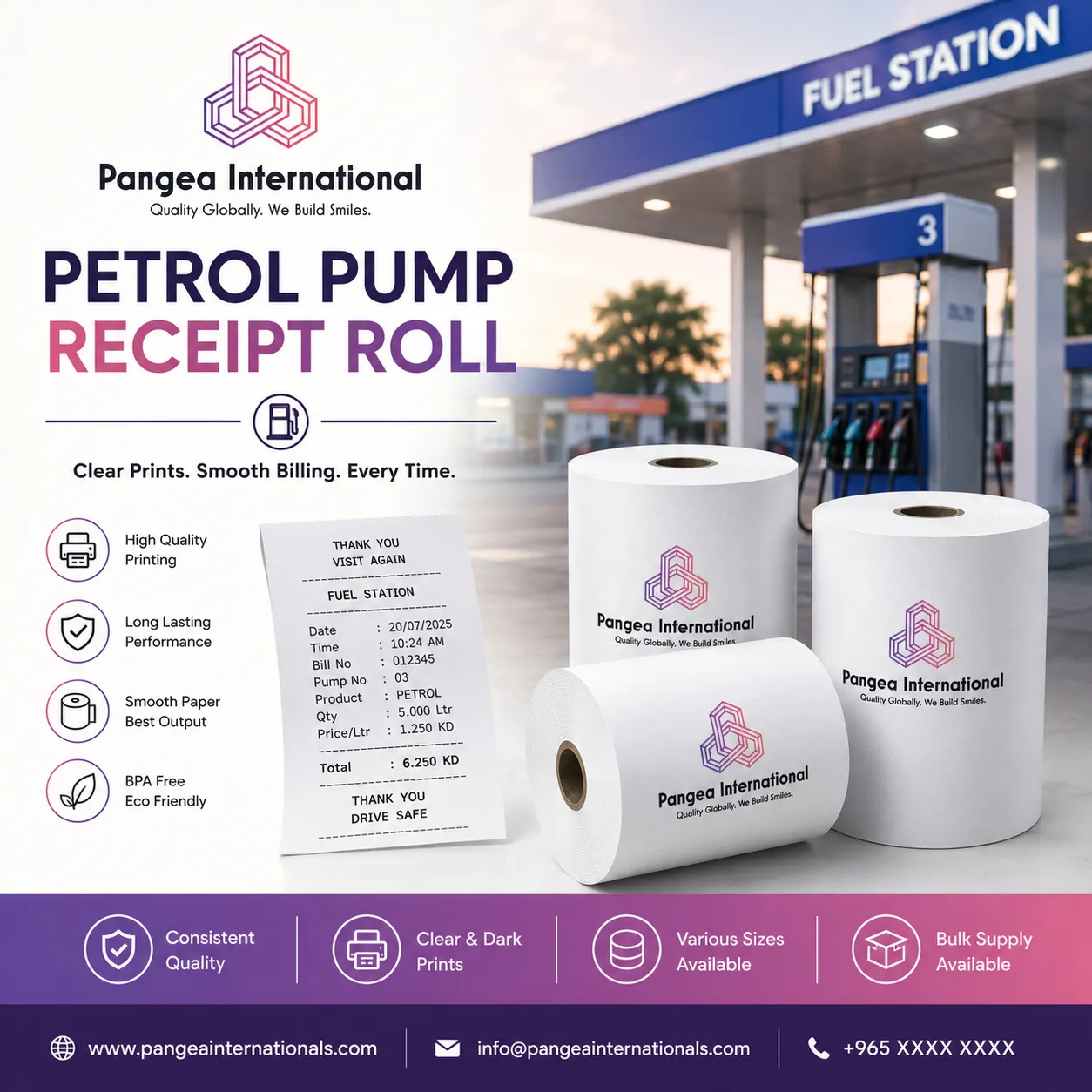
Every time a vehicle pulls up to a pump and the attendant hands over a small printed slip, a petrol pump receipt roll has just done its job quietly and completely. It's easy to overlook this product entirely, right up until the printer at your station jams during a busy evening rush, or a customer's fuel receipt comes out too faded to submit for expense reimbursement. At that point, a product nobody thinks about suddenly becomes the centre of a very frustrating conversation.
We've spent years manufacturing and supplying thermal paper products to retailers, billing counters, and fuel stations across Rajkot and Gujarat, and a petrol pump receipt roll is one of the more specialised products we handle, precisely because it faces conditions most receipt paper never has to deal with: outdoor heat, direct sunlight, fuel vapour, and the occasional monsoon downpour, all while needing to stay legible enough for a customer's fuel expense claim or a fleet operator's monthly accounting.
Maybe you're reading this because your station has been fielding faded-receipt complaints lately. Maybe you're setting up a new pump and want to get sourcing right from day one. Either way, what follows isn't a sales pitch dressed up as an article, it's the same walkthrough we'd give a customer on a call, written down so you can reference it whenever your station needs it.
This guide covers everything worth knowing before your next order: what makes this product different from standard billing paper, which sizes and specifications actually matter, why legibility carries extra weight here, and how to buy smart so your station never has a printer problem during peak hours.
What Is a Petrol Pump Receipt Roll, Exactly?
A petrol pump receipt roll is a thermal paper roll used specifically in fuel station billing systems, whether that's a printer built directly into the automatic dispensing unit at the nozzle, or a separate countertop or handheld billing machine used at smaller or semi-automated stations. It prints the transaction slip showing fuel type, quantity in litres, rate per litre, total amount, and the date and time of purchase, the exact information a customer needs for expense tracking or fuel reimbursement, all condensed onto a small slip of paper that has to remain legible well after the transaction itself is complete.
Functionally, a petrol pump receipt roll works the same way as any other thermal paper: a heat-sensitive coating reacts with the printer head to produce text, with no ink or ribbon involved. What sets it apart isn't the underlying technology, but the environment it operates in and the specific legibility demands placed on it, both of which this guide covers in detail throughout the sections that follow.
Why Petrol Pump Receipt Roll Quality Matters More Than You Think
Here's something worth considering: a petrol pump receipt roll doesn't just print a transaction record, it prints a document that often gets submitted for reimbursement, expense reporting, or fleet fuel accounting. Employers, accountants, and fleet operators routinely rely on these small slips as supporting proof for local travel or vehicle fuel claims, and a receipt that's faded, patchy, or unreadable within days undermines exactly the purpose it's meant to serve, sometimes weeks after the original transaction when there's no easy way to go back and request a replacement.
For GST-registered businesses claiming Input Tax Credit on commercial fuel purchases, or fleet operators reconciling monthly diesel spend across dozens of vehicles, a legible petrol pump receipt roll isn't a nice-to-have, it's a genuine documentation requirement. A faded receipt can mean a rejected reimbursement claim, a disputed expense report, or a frustrating trip back to the fuel station asking for a duplicate that may not even be possible to generate after the fact, since most billing systems and dispensing units don't retain a reprintable record indefinitely.
Here's what a poorly chosen roll actually costs a fuel station, beyond the price on the invoice:
-
Customer complaints: A driver who can't submit a faded receipt for reimbursement is likely to remember which station gave them the problem, and choose a competitor next time.
-
Operational downtime: A jammed printer at a busy pump during peak hours creates a queue and frustrates both the customer waiting and the attendant trying to fix it.
-
Wasted spend: Emergency purchases from whichever local shop has stock cost more per roll than a planned bulk order, and inconsistent stock quality across multiple pumps creates its own headaches.
### The Hidden Cost of Cutting Corners
Choosing the cheapest, unverified petrol pump receipt roll is a bit like filling a fleet vehicle with the cheapest fuel available without checking its quality. It might run fine for a while, but the cost of a failure, whether that's a rejected expense claim or a jammed printer during a busy shift, usually outweighs whatever was saved upfront, particularly once you factor in the staff time spent fielding complaints and the customer goodwill lost in the process.
We've spoken with fuel station operators who assumed all thermal rolls were interchangeable, only to discover that a cheaper batch faded within days rather than weeks, generating a wave of customer complaints about unreadable receipts precisely during the period when many customers submit monthly expense reports, a timing coincidence that made the problem considerably more visible and damaging than it might have been at a different point in the billing cycle.
Sizes and Specs: 2 Inch, 55mm, 57mm, 58mm, and Why the Naming Varies
Width is the most important specification, and this is exactly where a petrol pump receipt roll causes some genuine confusion. Depending on the manufacturer, the same practical width gets labelled as "2 inch," 55mm, 57mm, or 58mm, terms that are often used almost interchangeably in the Indian market even though they don't refer to identical dimensions.
|
Labelled Width |
Actual Width |
Typical Use |
|
2 inch |
Approximately 50-51mm |
Older billing machines and some compact printers |
|
55mm |
55mm |
Common at many fuel station billing systems |
|
57mm |
57mm |
Most widely used width across Indian POS and petrol pump printers |
|
58mm |
58mm |
Slightly wider variant used by some manufacturers |
In practice, 57mm is by far the most common actual width for a petrol pump receipt roll across Indian fuel stations, and "2 inch" is often used as loose shorthand for this same width even though 2 inches technically converts to roughly 50.8mm. Before ordering in bulk, always confirm the exact width against your printer's manual or by measuring your current roll directly, rather than relying on a supplier's label alone.
This naming inconsistency isn't unique to fuel stations, it appears across the broader thermal paper category in India, but it's worth being especially careful about here given how tightly the paper needs to match dispensing unit hardware that may not tolerate even a small width discrepancy the way a more flexible standalone billing machine would.
Length also varies, typically running 15, 20, or 25 metres depending on GSM and how your specific dispensing unit or billing machine is configured. A busy station processing hundreds of transactions a day benefits from longer rolls to reduce how often attendants need to reload, while a smaller station with lower footfall can manage comfortably with shorter lengths without excessive stock sitting unused for long stretches.
Automatic Dispensing Unit Printers vs Separate Billing Machines
Modern fuel stations, particularly those operated under IOCL, BPCL, and HPCL branding, typically use a printer integrated directly into the automatic dispensing unit at the nozzle, printing a receipt the moment a transaction completes. A petrol pump receipt roll for this kind of integrated system needs to match the specific dispensing unit manufacturer's exact width, core size, and often a particular GSM range specified by the equipment supplier.
These integrated systems are typically supplied and maintained under service contracts with the dispensing unit manufacturer, which sometimes leads station operators to assume they must purchase paper exclusively through that same channel. In practice, provided the specification matches exactly, sourcing a correctly specified petrol pump receipt roll from an independent manufacturer is generally a perfectly viable and often more cost-effective alternative, as long as the width, core diameter, and GSM range all align with what the equipment manufacturer originally specified.
Smaller, independent, or semi-automated fuel stations more commonly use a separate countertop or handheld billing machine, functionally similar to a standard retail POS terminal, printing a receipt after the attendant manually enters the transaction details. This setup offers more flexibility in choosing a petrol pump receipt roll, since standard POS paper specifications generally apply without the additional constraints that come with proprietary dispensing unit hardware.
If your station operates dispensing units from a specific manufacturer, it's worth confirming the exact paper specification with that manufacturer's documentation before ordering in bulk, since integrated systems tend to be less forgiving of a slightly mismatched roll than a standalone billing machine would be.
GSM and Coating Quality for This Product
GSM, or grams per square metre, measures paper thickness, and for a petrol pump receipt roll it typically ranges from 48 GSM on the lighter, more economical end up to 55-60 GSM on the heavier, premium end. Given the legibility concerns covered earlier around expense reimbursement and GST documentation, many fuel stations find that a slightly heavier GSM, rather than the cheapest available option, pays for itself in fewer customer complaints about faded receipts.
Coating quality matters just as much as GSM here, and arguably more than for an ordinary retail receipt. A well-coated petrol pump receipt roll produces consistently dark, legible text that holds up over the weeks a customer might wait before submitting an expense claim, while an inconsistent, budget-grade coating can fade to illegible grey well before that documentation is ever needed.
Given the outdoor storage conditions many fuel stations operate under, covered in more detail later in this guide, coating quality and fade resistance deserve particular attention when comparing suppliers, since a roll that performs adequately in a climate-controlled office environment may behave quite differently after sitting in a hot storage cabinet beside a fuel dispenser for several weeks during the peak of summer.
It's worth asking any supplier specifically how their coating formulation is tested for fade resistance under heat exposure, rather than accepting a generic GSM figure as a proxy for genuine quality. Two rolls at the same stated GSM can perform very differently once exposed to the specific heat and sunlight conditions a fuel station forecourt actually experiences on a daily basis.
BPA-Free Petrol Pump Receipt Roll: Why It Matters for Attendants
Standard thermal coating has historically relied on Bisphenol A, or BPA, a chemical developer now restricted across the EU and several US states due to health concerns tied to repeated skin contact over extended periods. Fuel station attendants handling receipts constantly throughout a shift, often with hands that have just handled a fuel nozzle, represent a genuinely relevant exposure consideration worth taking seriously.
A BPA-free petrol pump receipt roll costs only marginally more than standard stock and performs identically in print speed and darkness. For fuel station operators managing staff welfare alongside standard business considerations, BPA-free compliance is an increasingly reasonable baseline expectation, and it's worth asking any supplier directly rather than assuming all thermal paper is manufactured the same way. Pangea Retails supplies its full range, including every petrol pump receipt roll we produce, as 100% BPA-free, with documentation available on request.
How Does Thermal Printing Work in a Petrol Pump System?
It helps to understand the mechanics behind this product, since it explains almost every quality issue you'll ever encounter with a petrol pump receipt roll. Whether printed by an integrated dispensing unit or a standalone billing machine, the underlying technology is direct thermal printing: a row of tiny heating elements in the print head activates at precise points as paper feeds past, triggering a chemical reaction between a dye and a colour developer built into the coating, producing dark text with no ink or ribbon involved at any stage of the process.
This is why thermal printing is fast enough to keep pace with a busy forecourt during peak hours, and it's also why storage conditions matter so much for this specific product. If a roll has been sitting somewhere hot, exposed to direct sun or fuel vapour, part of the coating can pre-react from ambient conditions alone, producing faint grey patches even before it's ever loaded into a printer. Understanding this mechanism is exactly why the outdoor storage guidance covered later in this guide matters more here than for almost any other thermal paper application.
Troubleshooting: Why Do My Petrol Pump Receipts Keep Fading or Jamming?
Let's work through this like a checklist, since most complaints we hear about this product trace back to one of a handful of predictable causes, and correctly diagnosing which one you're dealing with saves considerable time compared to guessing at random.
Receipts fade within days rather than weeks almost always points to either a lower-grade coating than expected or poor storage conditions, particularly relevant given the outdoor heat and sun exposure many fuel stations contend with daily. Before assuming the paper itself is defective, check where and how it's been stored.
Frequent jams on an integrated dispensing unit printer typically traces back to a core diameter or outer roll diameter mismatch against the specific manufacturer's equipment specification, since these systems tend to be less forgiving of a slightly incorrect fit than a standalone billing machine.
Inconsistent print darkness across a single roll usually indicates uneven coating quality from a budget supplier, and switching to a more consistent, better-manufactured petrol pump receipt roll typically resolves this without any changes to the printer itself.
Receipts printing correctly but customers reporting illegibility weeks later points back to the GSM and coating quality discussion earlier in this guide. If this happens repeatedly, it's worth moving to a heavier GSM grade specifically chosen for extended legibility rather than continuing with economy-grade stock.
If you're managing multiple pumps or stations and notice the same issue appearing across several at once, that's a strong signal the problem lies with a specific batch or specification, not the printers themselves, and it's worth raising directly with your supplier.
A Buyer's Quick-Reference Glossary
If you're new to sourcing this category of paper, a few terms come up repeatedly in supplier conversations that are worth understanding before placing your first order. Getting comfortable with this vocabulary early saves considerable back-and-forth once you're actually negotiating specifications with a potential supplier for the first time.
-
Direct thermal: The printing technology used by virtually all modern petrol pump and POS printers, where heat directly activates the coating without any ribbon or ink cartridge involved.
-
GSM: Grams per square metre, the standard measure of paper weight and thickness, directly tied to fade resistance and legibility retention.
-
Core diameter: The size of the cardboard or plastic tube at the centre of the roll, which must match your printer's spindle exactly.
-
Dispensing unit (DU): The automated fuel pump hardware at the nozzle, often with an integrated printer requiring a specific paper specification set by the equipment manufacturer.
-
BPA-free: Coating manufactured without Bisphenol A, an increasingly standard expectation for institutional and staff-welfare-conscious buyers.
-
Fade resistance: How well printed text holds up against heat, light, and time, particularly important given the outdoor conditions and reimbursement-related legibility needs covered throughout this guide.
Walking into a supplier conversation already familiar with these terms tends to produce faster, more accurate quotes, since you can specify exactly what your station needs rather than relying on a supplier to guess based on a vague description of your equipment.
How to Choose the Right Petrol Pump Receipt Roll for Your Station
Let's make this practical. Here's the process worth working through before placing an order, whether you're stocking a single pump or coordinating supply across an entire multi-station network.
Confirm your printer type first. Whether you're running an integrated dispensing unit printer or a separate billing machine changes what specification you actually need.
Verify exact width, not just the label. As covered above, "2 inch," 55mm, 57mm, and 58mm get used loosely, so measure your current roll or check your equipment manual directly.
Choose GSM with legibility retention in mind. Given how often these receipts get used for reimbursement weeks after printing, a slightly heavier grade often makes more sense than the cheapest available option.
Ask about BPA-free certification. A simple question that separates suppliers who take quality seriously from those who don't.
Request a sample before bulk ordering. A test roll run through your actual printer, ideally stored under your station's real conditions for a few days first, tells you far more than any specification sheet.
Here's a checklist worth keeping on hand:
-
[ ] Confirm exact width against your printer or dispensing unit manual
-
[ ] Confirm core diameter and outer roll diameter fit your machine
-
[ ] Decide on GSM with reimbursement-grade legibility in mind, not just lowest cost
-
[ ] Ask specifically about BPA-free certification and documentation
-
[ ] Request a sample and test it under your station's actual storage conditions
-
[ ] Confirm GST-compliant invoicing is available
Real-World Examples: IOCL, BPCL, HPCL, and Private Fuel Stations
-
Major oil company stations (IOCL, BPCL, HPCL): Typically running integrated dispensing unit printers with specific manufacturer-defined paper requirements, often standardised across an entire regional network.
-
Independent and private fuel stations: More commonly using separate countertop or handheld billing machines, offering greater flexibility in paper sourcing.
-
Highway and long-route fuel stations: Higher transaction volumes from commercial and fleet vehicles, often benefiting from longer roll lengths to reduce reloading frequency during busy periods.
-
CNG and multi-fuel stations: Often running multiple billing systems side by side for different fuel types, sometimes with different printer specifications across each system.
-
Fleet-focused fueling stations: Serving commercial fleet operators who specifically rely on legible receipts for monthly fuel accounting and reimbursement processing.
Each of these operators depends on the same underlying requirement: a petrol pump receipt roll that fits their specific printer, survives their station's storage conditions, and stays legible long enough to serve its actual purpose.
It's worth noticing something else in that list too: the operators with the highest stakes in receipt legibility, fleet-focused stations and highway locations serving commercial traffic, are also the ones with the most to lose from a faded or illegible receipt. A private individual filling their own personal vehicle might not think twice about a slightly faded slip, but a fleet driver submitting that same receipt for reimbursement against a strict company expense policy has a much lower tolerance for anything less than clearly legible documentation. Matching how seriously your station treats paper quality to the composition of your actual customer base is worth thinking through deliberately rather than defaulting to whatever's cheapest.
Case Study: How a Gujarat Fuel Station Network Solved Its Receipt Complaint Problem
A network of independent fuel stations operating across several towns in Gujarat came to us with a recurring issue: customer complaints about faded receipts, concentrated specifically around the end of each month, right when many customers were submitting fuel expense claims for reimbursement to their employers or accounting departments.
After reviewing their paper sourcing, the pattern became clear. Each station had been buying whatever stock was locally available and cheapest, with no consistency in GSM or coating quality across the network, and no attention paid to how the paper was being stored, often in a cabinet positioned uncomfortably close to the dispensing units themselves, exposed to significant ambient heat throughout the day.
We worked with the network to standardise on a single, heavier-GSM, BPA-free petrol pump receipt roll specification across every station, along with simple guidance on storing stock away from direct heat sources. Within one billing cycle, complaints about faded receipts dropped sharply, and the network's procurement team reported that consolidating orders into a single bulk purchase across all stations also reduced their per-unit cost by roughly 14%.
The network's operations manager told us the complaint reduction mattered most around fleet accounts specifically, since several commercial fleet operators had been on the verge of switching to a competing station chain over the reimbursement documentation issues before the switch resolved the problem entirely.
Six months on, the network reported that reorder planning had also become considerably simpler, since every station now consumed paper at a predictable, documented rate rather than the inconsistent pattern caused by mismatched batches and varying storage practices across different locations. The procurement lead noted that the biggest surprise wasn't the cost saving itself, but how much staff time had previously been spent fielding and investigating individual complaints that, once traced back, all shared the same root cause.
Seasonal and Peak-Period Demand Planning
Fuel station transaction volumes fluctuate considerably around festival travel periods, long weekends, and agricultural harvest seasons in many parts of Gujarat, when both personal and commercial vehicle traffic spikes noticeably above baseline for days or even weeks at a stretch. A petrol pump receipt roll consumption pattern that looks stable most months can shift considerably during these peak periods, and stations that don't plan around this seasonality sometimes find themselves scrambling for stock precisely when demand across the entire region is highest.
A practical approach many station operators use is reviewing consumption data from the same period in the previous year and building in a reasonable buffer, typically an extra 15-20% above the calculated baseline, to account for the predictable but variable swings tied to travel seasons and regional events. This is considerably easier to manage once a station is tracking actual consumption patterns rather than simply reordering reactively whenever a visual check suggests stock is running low.
Highway-adjacent stations in particular should pay close attention to this kind of seasonal planning, given how much more pronounced their traffic swings tend to be compared to stations primarily serving local, day-to-day traffic within a single town or neighbourhood.
Advanced Tips for Sourcing This Product at Scale
### Outdoor Storage: Heat, Sun, and Fuel Vapour
A petrol pump receipt roll often gets stored in conditions no ordinary retail receipt paper ever faces: direct sun exposure near an open forecourt, ambient heat radiating from nearby equipment, occasional fuel vapour exposure, and monsoon humidity for several months of the year. All of these accelerate thermal coating degradation and can cause premature fading well before a roll is ever loaded into a printer.
Store stock in a shaded, ventilated area away from direct sunlight and heat-generating equipment, ideally in its original packaging until use. During monsoon months, sealed containers help protect against humidity, which can affect both print quality and how smoothly paper feeds through a printer. A storage cabinet positioned directly beside a dispensing unit, while convenient for quick access, is often precisely the worst location for a fresh supply of paper, given how much ambient heat these units radiate throughout the day, particularly in direct summer sun.
A simple, practical habit worth adopting: keep only a day or two's worth of stock in the immediate vicinity of each pump, with the bulk of your inventory stored properly in a shaded back-office area and replenished to individual pumps as needed. This limits how long any given roll sits exposed to the harshest conditions before it's actually loaded and used.
### Bulk Buying and Consumable Planning
Consolidating purchases into a single scheduled bulk order typically reduces per-unit cost by somewhere in the range of 12-18%, based on what we've seen across fuel station operators who make this switch. For multi-pump or multi-location networks, standardising specification across every station, as covered in the case study above, compounds this saving further while also improving consistency for customers.
### GST and ITC Considerations
For GST-registered fuel station operators, a petrol pump receipt roll purchased for business use generally falls under HSN code 4811, and Input Tax Credit can typically be claimed provided you hold a valid GST invoice from a registered supplier. Always request one, every time, even for smaller top-up orders, since documentation gaps on a recurring, high-frequency purchase like this can create disproportionate friction during an audit relative to the actual value involved.
Common Mistakes When Buying Petrol Pump Receipt Roll
Assuming "2 inch" always means the same width. As covered earlier, this label gets used loosely across suppliers, and confirming exact millimetres against your printer avoids a mismatched bulk order.
Choosing the cheapest GSM without considering reimbursement legibility. A slightly heavier grade often pays for itself in fewer faded-receipt complaints from customers relying on the slip for expense claims.
Ignoring storage conditions specific to a fuel station environment. Heat, sun, and fuel vapour exposure accelerate fading in ways a typical indoor retail counter never experiences, and treating storage guidance written for a shop counter as equally applicable here is a mistake worth avoiding.
Buying reactively instead of on a schedule. Emergency small purchases cost more per unit and increase the odds of inconsistent quality across a multi-pump network.
Not asking about BPA-free certification. An increasingly relevant question, particularly for station operators thinking about staff welfare alongside standard procurement criteria.
Assuming your dispensing unit's original paper specification never changes. Equipment manufacturers occasionally update specifications with newer hardware models, and a station running a mix of older and newer dispensing units may genuinely need different paper specifications across different pumps rather than one universal order.
Signs Your Current Supplier Isn't Serving Your Station Well
Not sure whether it's worth exploring alternatives? A few honest questions can clarify things quickly, and it's worth revisiting them even with a supplier you've used for years, rather than only reconsidering the relationship after complaints have already started piling up.
Does your supplier struggle to answer basic questions about GSM, coating chemistry, or BPA-free status without hesitation? A vague assurance isn't the same as an actual specification sheet or test documentation, and a supplier who can't produce one shouldn't be treated as a reliable long-term source for a product this closely tied to customer-facing documentation.
Have you noticed complaints about faded receipts creeping up over time, even though you believe you're ordering the same specification consistently? This is one of the clearest signs that GSM or coating quality has quietly drifted between batches without anyone flagging the change to you directly.
Does your supplier understand the specific outdoor storage challenges a fuel station faces, or do they simply repackage standard indoor-retail-grade thermal paper without any consideration for heat, sun, and fuel vapour exposure? This distinction matters more than most station operators realise until they've experienced the difference in fade resistance firsthand.
Finally, does reordering feel more complicated than it should, with unclear pricing, inconsistent lead times, or a supplier who seems surprised every time you place a bulk order rather than treating it as routine? A supplier genuinely set up to serve fuel stations makes this part of your operation boring, in the best possible sense.
Environmental Considerations for Fuel Station Operators
Sustainability is becoming a more visible purchasing factor across the fuel retail sector, not just a marketing checkbox. Standard thermal-coated paper is genuinely difficult to recycle through conventional paper streams because of its chemical coating, a challenge shared across every business using this product regardless of scale or location.
Choosing a well-manufactured, consistent petrol pump receipt roll indirectly reduces waste, since fewer misprints and reprints occur compared to inconsistent, budget-grade stock that fades or jams partway through a busy period. Some larger fuel station networks, particularly those affiliated with major oil companies pursuing broader sustainability commitments, have started asking suppliers directly about base paper sourcing and coating chemistry as part of standard vendor evaluation.
For station operators balancing sustainability goals against the operational necessity of printed fuel receipts, particularly given how often these receipts serve a genuine documentation purpose for reimbursement and GST claims, working with a manufacturer who can speak honestly about sourcing and coating practices offers a reasonable middle ground.
Building a Long-Term Supply Relationship for Your Station
There's a meaningful difference between finding a supplier for a single order and building a relationship that actually supports your fuel station as it operates day to day. The station operators who get the most value from their paper sourcing tend to treat it less like a series of one-off transactions and more like an ongoing operational partnership, one that adapts as your station's equipment and customer base evolve over time.
What does that look like in practice? A supplier who understands your specific printer setup, whether integrated dispensing units, standalone billing machines, or a mix across multiple pumps, without needing it re-explained every time you reorder. Proactive communication about potential supply disruptions before they become an emergency during a busy period. A willingness to discuss storage guidance specific to your station's actual conditions, rather than offering generic advice that doesn't account for outdoor heat and fuel vapour exposure.
It also means honesty about what a given specification can and can't deliver. A supplier who tells you upfront that a particular economy-grade paper isn't well suited to your station's outdoor storage conditions, rather than selling it to you anyway, is one worth continuing to work with as your station's needs evolve.
Fleet Accounts and Why Receipt Quality Affects Customer Retention
Commercial fleet operators represent a meaningful and often underappreciated customer segment for many fuel stations, and their purchasing decisions are frequently influenced by factors beyond just fuel price. A fleet operator managing dozens of vehicles depends on consistent, legible receipts to reconcile monthly fuel spend against individual driver claims, and a station that reliably produces readable petrol pump receipt roll output becomes a meaningfully more attractive long-term partner than one generating a steady stream of illegible slips that create administrative headaches every month.
We've heard directly from fleet-focused customers, echoed in the case study covered earlier in this guide, that receipt quality genuinely factors into which stations they direct their drivers toward, particularly for accounts large enough that even a small percentage of rejected or disputed expense claims adds up to real administrative overhead each month.
For fuel station operators actively courting or retaining fleet business, this is worth treating as more than a minor operational detail. Reliable, legible receipts are a small but genuine competitive differentiator in a market where fuel pricing itself often has limited room for a station to stand out from nearby competitors.
Where to Buy Petrol Pump Receipt Roll in India: Why Pangea Retails
Pangea Retails manufactures and supplies petrol pump receipt roll stock across the widths, lengths, and GSM grades covered in this guide, tested for BPA-free compliance and backed by GST-compliant invoicing for every order, whether you need stock for a single station or a coordinated bulk supply across a multi-pump network.
Sourcing directly from a manufacturer rather than a reseller several steps removed from production means clearer answers about GSM consistency, coating quality, and fade resistance, plus pricing that improves meaningfully as your order volume grows. You can browse our current stock of the 57mm x 25 Mtr POS Roll directly on the Pangea Retails shop page, a widely compatible specification for both integrated dispensing units and standalone billing machines.
For related buying guidance, our 57mm POS roll buying guide and our piece on why every business should switch to BPA-free paper are both useful companion reads.
Frequently Asked Questions About the Petrol Pump Receipt Roll
What width is a standard petrol pump receipt roll?
57mm is the most common actual width across Indian fuel stations, though it's sometimes labelled loosely as "2 inch," 55mm, or 58mm depending on the supplier, so always confirm the exact measurement before bulk ordering.
Why does receipt legibility matter more at a petrol pump?
Fuel receipts are frequently used for expense reimbursement, fleet fuel accounting, and GST documentation, often submitted weeks after the transaction, so a faded receipt can mean a rejected or disputed claim.
Is a BPA-free petrol pump receipt roll available in India?
Yes, Pangea Retails supplies its full range as 100% BPA-free, with test documentation available on request for fuel station operators and fleet-focused businesses.
How should I store petrol pump receipt roll stock?
Keep it in a shaded, ventilated area away from direct sunlight, heat-generating equipment, and fuel vapour exposure, since these conditions accelerate thermal coating degradation more than typical indoor retail storage.
Can I claim GST input tax credit on petrol pump receipt roll purchases?
Yes, GST-registered businesses can typically claim Input Tax Credit on this purchase when bought for business use, provided the order is supported by a valid GST invoice from a registered supplier.
Conclusion: Get This Small Detail Right, and Your Station Runs Smoother
At the end of the day, a petrol pump receipt roll is a small consumable carrying outsized responsibility, serving as a customer's proof of purchase for expense claims, fleet accounting, and GST documentation, often weeks after the actual fuel transaction. Matching the right width, choosing GSM with legibility retention in mind, and storing stock properly against the specific outdoor conditions a fuel station faces is what separates a station that never thinks about this problem from one that fields complaints every month.
We know that's an unusual thing to promise in a buying guide, that success looks like thinking about this less, not more, but that's genuinely the outcome worth aiming for. The station operators who handle this well aren't the ones with the most complicated procurement process; they're the ones who understood the specific demands of their outdoor environment early, matched their paper to those conditions, and moved on to running the rest of their operation without this particular headache resurfacing every month around reimbursement season.
Pangea Retails has built its petrol pump receipt roll supply around exactly these fundamentals, so fuel stations across Rajkot and Gujarat can order with confidence rather than trial and error. If you're ready to standardise your station's supply or simply want a sample before committing to a bulk order, our team is ready to confirm the exact specification your printer needs. Reach out today, and let's make sure every receipt your station prints does its job properly.