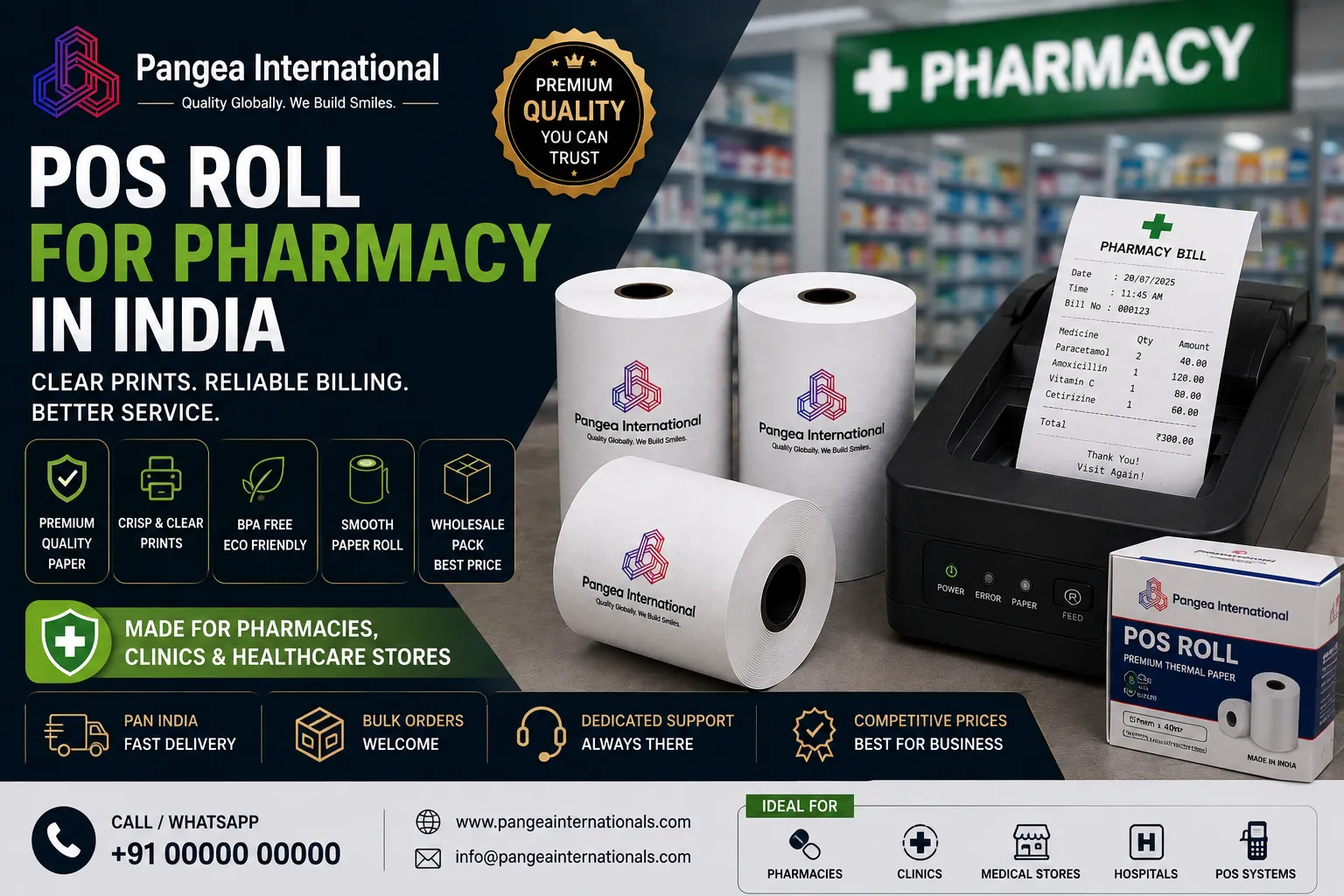
Every pharmacy bill in India ends the same way: a strip of paper sliding out of a billing printer with the medicine names, batch numbers, GST amount, and a "thank you" line at the bottom. That strip comes from a POS roll, and if you run a pharmacy, you already buy this product every single month without giving it a second thought. We think that is a mistake, and by the end of this guide, you will understand exactly why.
We have spent years supplying thermal paper to retail counters across Gujarat, and pharmacies are one of the trickiest customers to get right. A chemist shop is not a grocery store. A pharmacy bill often needs to be referenced weeks later for an insurance claim, a warranty, or a compliance check, and a POS roll that fades in ten days simply does not work in that context. So this article is not another generic "buy thermal paper" page. It is written specifically for pharmacy owners, hospital pharmacy managers, and chemist shop staff who need to choose the right POS roll for pharmacy billing, understand why it matters more than they think, and know exactly what to ask before placing a bulk order.
By the time you finish reading, you will know which POS roll size fits your billing counter, what GSM and coating actually mean for prescription slip legibility, how BPA-free paper protects your staff, what the GST and HSN rules say about this purchase, and how a real Rajkot pharmacy group solved a recurring billing problem simply by changing its POS roll supplier. We have also included a 20-keyword long-tail table, a full FAQ section written for quick answers, and a practical checklist you can literally hand to your purchase staff today.
Why Your Pharmacy's POS Roll Choice Matters More Than You Think
Ask any pharmacist what keeps their counter running smoothly, and paper is rarely the first answer. Yet a pharmacy that runs out of its POS roll mid-afternoon, or hands a customer a receipt that has already started fading by the time they reach the parking lot, is dealing with a problem that traces back to one overlooked purchasing decision.
Here is the uncomfortable truth: a pharmacy prints more receipts, per square foot of counter space, than almost any other retail category. Every strip, every syrup bottle, every over-the-counter purchase generates a bill, and during flu season or a festival rush, that billing counter can be under more pressure than a busy supermarket till. The POS roll for pharmacy use is not a background consumable. It is a working part of your daily compliance and customer service operation.
Consider the scale of what is riding on this decision. India's pharmacy retail market was valued at roughly USD 44.05 billion in 2025 and is projected to grow at a compound annual rate of 4.8% through 2029, according to Statista Market Insights. Meanwhile, the country's point-of-sale terminal footprint expanded nearly 29%, from 8.6 million to 11.2 million terminals between January 2024 and mid-2025, per Worldline's India Digital Payments Report. Every one of those terminals, in every pharmacy that owns one, needs a steady, reliable supply of the right POS roll to keep functioning.
We are not exaggerating when we say that choosing the wrong POS roll for your pharmacy creates a chain reaction: faded receipts lead to customer disputes, printer jams lead to queues, and inconsistent paper grade leads to a compliance headache the day an auditor asks for a legible copy of a three-month-old bill. Getting this one purchasing decision right removes an entire category of daily friction from your pharmacy operations.
The Growing Pressure on Pharmacy Billing Counters
Digital payments have changed how fast a pharmacy counter needs to move. UPI alone processed 228.3 billion transactions across India in 2025, up 29.3% from 172.2 billion the year before, and a meaningful share of that volume now happens at pharmacy counters as customers tap, scan, and expect an instant printed confirmation alongside their medicine bill.
That speed puts real pressure on your hardware and your consumables. A pharmacy billing counter that used to print twenty bills an hour during a quiet afternoon can now see that number spike sharply the moment a nearby clinic finishes its OPD hours. If your POS roll for pharmacy billing cannot keep pace, physically or in print quality, that pressure shows up exactly where you can least afford it: in front of a waiting customer.
There is also a longer-term demand story behind all of this. Roughly 77 million people in India live with diabetes, according to figures cited by market researchers tracking the domestic pharmacy sector, and the World Health Organization has projected that chronic conditions will account for a majority of deaths in the country. Chronic disease management means repeat pharmacy visits, month after month, for the same patients, which in turn means a steady, predictable stream of bills that a pharmacy's POS roll needs to support reliably over the long run, not just during an occasional rush. Government infrastructure is reinforcing this trend too: the Reserve Bank of India's Payments Infrastructure Development Fund had supported roughly 5.45 crore digital payment touchpoints across tier-3 to tier-6 towns as of late October 2025, extending card and QR-based billing, and the receipts that come with it, deep into exactly the kind of semi-urban and rural markets where independent chemist shops are most common.
What Exactly Is a POS Roll - and Why Pharmacies Use It Differently
A POS roll is a roll of thermal paper used inside a point-of-sale printer, card machine, or billing terminal. There is no ink cartridge or ribbon involved. The paper itself is coated with a heat-sensitive layer, and the printer head applies precise heat to darken specific points on that coating, forming the numbers and text you see on your receipt.
For a general retail store, that is the whole story. For a pharmacy, it is only half of it. A pharmacy POS roll is doing more work than a supermarket receipt, because a pharmacy bill typically carries information that has downstream legal and clinical weight: medicine names, batch numbers, expiry references, GST breakup by HSN code, and sometimes a prescription reference number tied to a Schedule H or H1 drug sale.
We have watched pharmacy owners assume that "thermal paper is thermal paper," order whatever is cheapest, and only realise the mistake weeks later when a customer returns with a faded bill for a refund or an insurance claim that a plain, low-grade roll simply cannot support. The POS roll your pharmacy uses is effectively a compliance document with a shelf life, and that changes what "good enough" actually means for this purchase.
How a Pharmacy POS Roll Differs From a Regular Retail POS Roll
|
Factor |
General Retail POS Roll |
POS Roll for Pharmacy |
|
Typical content on the bill |
Item name, price, total |
Medicine name, batch, expiry, GST/HSN, sometimes Rx reference |
|
How long the bill needs to stay legible |
A few days, often discarded same day |
Weeks to months, for insurance claims, returns, audits |
|
Recommended GSM |
48–55 GSM often sufficient |
58–70 GSM recommended for longer legibility |
|
BPA-free priority |
Nice to have |
Strongly recommended - staff handle receipts near medicines and patients |
|
Regulatory sensitivity |
Low |
Higher - Schedule H/H1 records, GST audit trail, drug license inspections |
|
Storage conditions |
Standard stockroom |
Often stored alongside temperature-sensitive medicines, needs careful placement |
The width you need is usually determined by your billing hardware rather than by the fact that you run a pharmacy. Compact chemist counters running a handheld or portable billing device typically use a 57mm POS roll, while larger pharmacy chains and hospital pharmacy counters with a full countertop receipt printer usually run a 79mm or 80mm POS roll to fit longer, itemised bills with a full medicine list and GST breakup.
The Real Problems Pharmacies Face With the Wrong POS Roll
Let's talk honestly about what goes wrong. We hear the same handful of complaints from pharmacy owners, again and again, and almost all of them trace back to the same root cause: choosing a POS roll for pharmacy billing based on price alone, without checking specification, grade, or supplier reliability.
Faded Prescription Slips and Compliance Risk
A thermal receipt fades naturally over time, but a low-grade, poorly coated roll fades far faster than it should, sometimes within days rather than months. For a pharmacy, that is not just an inconvenience. If a customer returns a medicine for exchange, or a health insurer requests a copy of a bill for reimbursement, and the receipt is already unreadable, your pharmacy is the one left explaining the gap.
We have heard this exact story from more than one chemist shop owner: a customer walks in three weeks after purchase with a receipt that looks blank except for a faint grey outline, asking for a refund on an unopened product, and there is genuinely no way to verify the purchase without digging through the billing software.
Printer Jams During Peak Billing Hours
A pharmacy counter rarely has downtime to spare, especially during flu season, festival rushes, or right after a nearby clinic's OPD hours end. A POS roll with the wrong core diameter, or an outer diameter too large for your specific printer compartment, jams at exactly the wrong moment, and repeated jamming from a mismatched roll can quietly damage your printer's feed mechanism over time.
BPA Exposure Risk for Pharmacy Staff
This one deserves particular attention in a healthcare setting. Older thermal paper formulations use Bisphenol-A (BPA) in the heat-sensitive coating, a chemical increasingly linked to health concerns with repeated skin contact. Pharmacy staff handle dozens, sometimes hundreds, of receipts a day, often right next to the medicines they are dispensing to patients. The European Union banned BPA in thermal paper back in 2020, and Indian regulatory guidance is moving in a similar direction. A pharmacy, of all businesses, has good reason to be ahead of that curve rather than behind it.
GST/Schedule H Documentation Gaps
Pharmacy billing sits inside a tighter regulatory net than most retail categories. Schedule H and H1 drugs require a documented sale, GST invoicing needs to be accurate and traceable under HSN code 4811 for thermal paper products, and a drug license inspection can, in theory, ask for legible historical billing records. A POS roll that cannot hold a clear print for the required retention period is not just a paper quality issue anymore; it becomes a genuine compliance exposure for the pharmacy owner.
Independent Chemist, Pharmacy Chain, or Hospital Pharmacy: Different POS Roll Needs
Not every pharmacy has the same billing profile, and the right POS roll for pharmacy use can shift meaningfully depending on what kind of pharmacy you actually run. We break this down into three broad categories, based on the patterns we see most often among our own customers.
Independent, Single-Counter Chemist Shops
A single-pharmacist chemist shop, common across most Indian neighbourhoods, typically prints a moderate daily receipt volume with a mix of OTC purchases and prescription fills. Most of these shops run either a compact handheld device or a single desktop billing printer, and a 57mm or a single 79mm POS roll specification, ordered monthly in moderate bulk, is usually enough. The priority here tends to be reliable availability and straightforward GST invoicing over anything more elaborate, since a small shop often cannot absorb the cost of a stock-out the way a larger chain can.
Multi-Outlet Pharmacy Chains
A pharmacy chain running several outlets across a city or region benefits enormously from standardising a single POS roll specification, width, GSM, and BPA-free status, across every location, exactly as the Rajkot pharmacy group in our case study did. The priority shifts toward consolidated bulk purchasing, consistent invoicing for centralised accounting, and predictable supply that does not depend on any single store manager's local sourcing habits.
Hospital Pharmacies and High-Volume Dispensaries
A hospital pharmacy or a large dispensary attached to a diagnostic centre typically prints the highest daily volume of any pharmacy category, often with longer, more detailed bills covering multiple medicines per visit, insurance references, and department-level billing codes. These settings usually justify the heavier 65–70 GSM end of the POS roll spectrum, given how frequently hospital billing gets referenced later for insurance reimbursement, and often benefit from a dedicated account relationship with a supplier who can guarantee volume and turnaround during peak admission periods.
Choosing the Right POS Roll Size for Your Pharmacy
Once you understand why the stakes are higher for a pharmacy, choosing the right POS roll for pharmacy use comes down to matching three things correctly: width, paper grade, and safety profile.
57mm vs 79mm/80mm - Which Fits Your Billing Counter?
Ask yourself one question first: what does your printer's manual say? Not what your neighbouring chemist uses, not what looks cheaper on a supplier's price list - the actual specification printed inside your billing machine's manual or on the box the last working roll came in.
-
57mm POS roll: Fits handheld card machines, portable billing devices, and compact counters common in single-pharmacist chemist shops and smaller neighbourhood medical stores. Ideal when receipts are short - item, amount, GST total.
-
79mm/80mm POS roll: Fits desktop or countertop billing printers common in larger pharmacies, hospital pharmacy counters, and pharmacy chains that print a full itemised bill with medicine names, batch numbers, and a detailed GST breakup.
Many pharmacy chains actually run both. A mobile billing tablet at a satellite counter might use a 57mm roll, while the main store printer runs an 80mm roll for full, itemised customer bills. If that describes your setup, keep the two specifications clearly labelled and stored separately - mixing up boxes in a busy pharmacy stockroom is a surprisingly common, entirely avoidable source of downtime.
GSM and Paper Grade for Pharmacy Records
GSM, or grams per square metre, tells you how thick the base paper is, and thickness correlates closely with how long a printed bill stays legible. For a pharmacy specifically, we recommend leaning heavier than you might for a typical retail counter.
|
GSM Range |
Best Suited For |
Pharmacy Recommendation |
|
48 GSM |
Same-day, low-retention receipts |
Not ideal - fades too quickly for medicine bills |
|
55 GSM |
General retail, short-term receipts |
Acceptable for OTC-only, low-value counters |
|
58–65 GSM |
Records kept for weeks to months |
Recommended default for most pharmacies |
|
70 GSM |
Extended archival, insurance-heavy billing |
Best for hospital pharmacies and chains handling frequent reimbursement claims |
A pharmacy bill often needs to outlive the transaction itself. A patient may need it for an insurance claim filed six weeks later, a warranty exchange on a medical device, or a family member cross-checking a prescription history. Choosing a heavier GSM POS roll for pharmacy billing costs marginally more per roll, but it is the cheaper option once you account for the customer disputes and reprints a faded receipt eventually causes.
BPA-Free Thermal Paper: Non-Negotiable for Healthcare
We said it above, and we will say it again with more emphasis here: a pharmacy should never compromise on BPA-free POS roll paper. This is not a marketing checkbox. It is a direct occupational and public-health consideration for a business built around health.
When you evaluate a supplier, ask for a written BPA-free certification or lab test report for the specific batch you are ordering, not a general company-wide claim. A reputable manufacturer of POS roll for pharmacy use will have this ready without hesitation. It is also worth asking what BPA has been substituted with - some manufacturers switch to Bisphenol-S (BPS), which some researchers view as carrying similar concerns, so "BPA-free" alone is not always the complete picture.
Common Mistakes Pharmacies Make When Buying a POS Roll
We see the same handful of buying mistakes repeat themselves across pharmacies of every size, from a single-counter neighbourhood chemist to a five-outlet regional chain. None of these mistakes are complicated to avoid once you know to look for them.
Buying purely on price per roll
The cheapest POS roll for pharmacy billing on a distributor's price list is rarely the cheapest option once you account for faded receipts, customer disputes, and printer maintenance caused by inconsistent paper quality. A two-rupee saving per roll disappears quickly against a single afternoon lost to a jammed printer during peak hours.
Ignoring core size in favour of width alone
A roll can be labelled with the correct width and still refuse to sit properly on your printer's spindle because the core diameter does not match. Pharmacy staff sometimes force a slightly wrong core onto the spindle to save time, which can damage the printer's feed mechanism over repeated use and turn a small paper mistake into an expensive hardware repair.
Treating BPA-free as optional
As covered earlier, this is one area where a pharmacy genuinely cannot afford to cut corners, given the direct staff and patient proximity involved in daily receipt handling.
Splitting purchases across too many small vendors
Multi-outlet pharmacy groups especially fall into this trap, letting each store manager buy independently from whichever local shop is closest. It fragments GST documentation, multiplies reconciliation work, and usually costs more overall than a single consolidated bulk order would.
Overlooking storage conditions entirely
A perfectly good POS roll can still fail a pharmacy if it sits in a hot stockroom or near a sunlit window for weeks before use. The paper degrades before it is even loaded into a printer, and by the time anyone notices, an entire batch may already be compromised.
Buying Locally vs Buying Online: What Works Best for Pharmacies
Pharmacy owners often ask whether it is better to buy a POS roll for pharmacy billing from a nearby stationery shop, a large online marketplace, or a direct manufacturer. Each route has trade-offs worth understanding before you commit to a recurring supplier relationship.
A local stationery vendor offers convenience for emergency, same-day top-ups, but rarely offers consistent GSM documentation, BPA-free certification, or GST-compliant invoicing as a matter of course. This works fine as a backup option but is a fragile foundation for your primary supply chain, especially for a pharmacy where documentation matters.
A large online marketplace often has competitive listed pricing, but batch-to-batch consistency can vary meaningfully between sellers, and getting a straight answer about paper grade, coating substitution, or lab test documentation can be slow or simply unavailable through a marketplace messaging system.
Buying directly from a manufacturer or a specialised regional supplier, such as Pangea Retails for pharmacies across Gujarat, typically offers the most reliable combination: consistent specification across every batch, documented BPA-free compliance available on request, proper GST invoicing by default, and a direct relationship where a pharmacy can ask specific technical questions and get a specific answer, rather than a generic listing description. For a recurring, business-critical consumable like this one, that reliability tends to matter more over a year than a marginally lower price per roll on a one-off order.
A useful test we suggest to pharmacy owners weighing these options: call or message the supplier with one specific technical question, such as the exact core diameter available for a given width, or whether a lab report accompanies BPA-free claims, and see how quickly and precisely they answer. A supplier who treats a POS roll for pharmacy billing as a serious, specification-driven product will answer that question directly. One who treats it as an undifferentiated commodity usually will not, and that gap tends to show up later in inconsistent batches.
Environmental and Sustainability Considerations for Pharmacies
Sustainability is becoming a genuine purchasing consideration for pharmacies, not just a marketing checkbox on a supplier's website. Standard thermal paper is difficult to recycle through conventional paper recycling streams because of its chemical coating, and a growing number of pharmacy chains are asking suppliers directly about sourcing and disposal practices before committing to large orders.
When evaluating a POS roll for pharmacy billing from a sustainability angle, look for a supplier who can speak specifically to base paper sourcing and manufacturing waste practices, rather than offering a vague, undocumented sustainability claim. Pangea Retails works with accountable paper supply chains and is happy to discuss sourcing specifics directly with pharmacy customers who ask.
There is also a practical link between paper quality and waste that pharmacies sometimes miss. A thicker, better-coated roll produces fewer misprints and reprints than the thinnest, cheapest paper available, which indirectly reduces overall consumable waste across a busy pharmacy billing counter over the course of a year, even before considering formal recycling questions.
GST, HSN Code & Compliance for Pharmacy POS Rolls in India
For Indian pharmacy owners and distributors, thermal paper products, including every standard POS roll for pharmacy billing, generally fall under HSN code 4811, covering coated and treated paper products. GST applies at the standard applicable slab for paper-based consumables, and GST-registered pharmacies can typically claim Input Tax Credit (ITC) on this purchase when it is made for business use and backed by a valid, GST-compliant invoice from a registered supplier.
This matters more for a pharmacy than it might for a general retail shop, because pharmacies already operate under closer regulatory scrutiny through their drug license and Schedule H/H1 recordkeeping requirements. A missing or improperly documented invoice for a low-value, high-frequency item like a POS roll can create disproportionate friction during a GST audit or a drug license inspection, simply because it is easy to overlook among larger, more obvious expense categories.
A few practical habits we recommend to every pharmacy client:
-
Always request a proper GST invoice for every POS roll order, regardless of order size.
-
Keep digital copies of these invoices tagged by month, alongside your other consumables spending, so an audit trail exists without manual reconstruction later.
-
Consolidate your pharmacy's POS roll purchases with a single registered supplier where possible, since matching invoices from three or four small, informal vendors each month multiplies the reconciliation work for very little pricing benefit.
-
Confirm your supplier's GSTIN is valid and active before placing a large bulk order, particularly if you have not ordered from them before.
How to Choose a POS Roll Supplier for Your Pharmacy: A Practical Checklist
We put this list together after years of hearing the same recurring problems from pharmacy owners across Gujarat. Use it the next time you are evaluating a POS roll supplier for pharmacy billing, whether it is your first order or you are reconsidering an existing vendor relationship.
Pharmacy POS Roll Supplier Checklist:
-
☐ Supplier can confirm exact width (57mm or 79mm/80mm) matching your printer manual
-
☐ Supplier can confirm exact core diameter, not just the outer roll width
-
☐ BPA-free certification or lab test report is available on request, per batch
-
☐ GSM options of at least 58 GSM or higher are offered for archival-grade bills
-
☐ GST-compliant tax invoice is issued automatically with every order
-
☐ Supplier can commit to consistent stock availability, not just a one-time competitive quote
-
☐ Sample rolls are available before a bulk commitment
-
☐ Delivery timelines are realistic for your order volume and location
-
☐ Supplier can accommodate a repeat monthly or quarterly order without renegotiating specs each time
-
☐ Pricing is transparent for bulk tiers, without hidden minimum order surprises
If a supplier hesitates on more than one or two of these points, particularly the BPA-free documentation or the GST invoice, treat that as a warning sign rather than a minor inconvenience. A pharmacy has less room for supplier ambiguity than almost any other retail category.
Case Study: How a Rajkot Pharmacy Group Solved Its Billing Roll Problem
A four-outlet chemist and pharmacy group operating across Rajkot came to Pangea Retails in early 2026 with a familiar complaint. Each of its four stores had been sourcing POS rolls independently from whichever local stationery vendor happened to be nearby, resulting in three different paper grades in circulation across the group at any given time, none of them documented as BPA-free.
The pharmacy group's finance manager flagged two recurring problems during a routine internal review. First, customer refund requests tied to faded receipts had become a small but steady monthly irritant, averaging roughly six to eight disputed transactions per outlet per month, most resolved only after cross-checking the billing software manually. Second, none of the four outlets had a consistent GST invoice trail for their POS roll purchases, since each store manager was buying in small, ad hoc quantities from a different local shop whenever stock ran low.
After switching to Pangea Retails and standardising on a single 79mm x 25 Mtr, 65 GSM, BPA-free POS roll specification across all four outlets, the group reported a roughly 70% drop in receipt-related refund disputes within the first two months, largely because bills were now staying legible well beyond the typical return window. The finance team also noted that consolidating purchases with one supplier meant every order arrived with a proper GST invoice, cutting the time spent reconciling paper consumables during monthly GST filing by a noticeable margin.
Just as importantly, the group moved to a single monthly bulk order synced across all four stores, timed to its billing cycle, and has not experienced a stock-out since making the switch, including through a particularly high-footfall period around the monsoon flu season when transaction volumes at two of its outlets roughly doubled compared to a typical month. This is a pattern we see repeatedly: pharmacies that treat their POS roll sourcing as a planned, standardised purchase rather than a reactive, store-by-store scramble tend to see measurable improvements within a single quarter, both in cost and in fewer customer-facing problems.
Advanced Tips for Managing POS Roll Consumption in a Pharmacy
Once you have the right specification locked in, a handful of operational habits make a meaningful difference to how well your POS roll for pharmacy billing performs day to day.
Storage Best Practices for Humid Indian Climates
Thermal paper is chemically sensitive to heat, direct sunlight, and humidity, all of which can fade the printed text well before the roll is even used. This matters especially in Gujarat and much of coastal or high-humidity India during the monsoon months, when ambient moisture can noticeably shorten the effective legibility window of a stored roll.
-
Store rolls in their original packaging until they are loaded into the printer.
-
Keep stock away from windows, direct sunlight, and any heat-generating equipment such as photocopiers or printers left running nearby.
-
In humid regions, consider a sealed container or a climate-controlled stockroom for longer-term bulk stock.
-
Never store POS rolls in the same cabinet as strong-smelling chemicals or certain cleaning agents, since some coatings can react with airborne solvents over time.
-
Keep printed pharmacy bills that customers may need later away from PVC-based plastic folders or laminate pouches, which can accelerate fading through chemical interaction.
Bulk Buying and Inventory Planning
Pharmacies with predictable footfall can plan POS roll purchasing the same way they plan medicine stock: against actual consumption data rather than guesswork. If your pharmacy prints roughly 150 bills a day, a quick calculation against your roll's typical receipt count per length tells you almost exactly how many rolls you need per month, removing the guesswork that leads to either emergency small-batch purchases or excess stock tying up working capital.
Buying in bulk cartons rather than small repeat batches consistently reduces the per-unit cost of a POS roll for pharmacy billing, often more meaningfully than pharmacy owners expect before requesting their first bulk quote. For a multi-outlet pharmacy group, consolidating the entire chain's requirement into a single quarterly order, rather than letting each store manager purchase independently, typically produces the strongest pricing and the most predictable supply.
Multi-Outlet Standardization
If you run more than one pharmacy location, standardising on a single POS roll specification, width, GSM, and BPA-free status, across every outlet removes an entire category of avoidable problems: mismatched core sizes causing jams, inconsistent print quality confusing regular customers, and fragmented GST invoicing complicating your monthly reconciliation. The Rajkot case study above is a direct illustration of exactly this principle in practice.
A Quick Reference: Matching Your Printer Model to the Right Specification
Before your next bulk order, physically check three things on your billing printer: the paper width slot, the maximum roll diameter the compartment can close around, and the core size of the spindle. Cross-reference these three numbers against your supplier's specification sheet rather than relying on memory or a previous invoice, since printer models are sometimes swapped or upgraded without every staff member being informed.
Training Your Billing Staff on Roll Handling
A surprising share of printer jams and premature roll failures in pharmacies trace back not to the paper itself but to how it is loaded and handled at the counter. A short, five-minute training session for new billing staff, covering how to load a roll correctly, how to recognise a mismatched core before forcing it into place, and how to store an opened roll between shifts, pays for itself quickly in fewer service interruptions.
It also helps to designate one person per shift responsible for monitoring roll stock at the counter, rather than leaving it to whoever notices the printer running low. A pharmacy that gets caught without a spare POS roll during a busy afternoon loses more in staff time and customer frustration than the cost of the roll itself many times over.
How Print Quality Quietly Affects Patient Trust
It is easy to underestimate how much a small, physical detail like a crisp, legible bill contributes to a patient's overall impression of a pharmacy. A faded, patchy receipt handed over after a medicine purchase can read, even subconsciously, as a sign of a poorly run counter, while a sharp, dark, well-printed bill reinforces the same sense of care and attention that a good pharmacist already brings to counselling and dispensing. For a business built on trust, that small detail is not as trivial as it first appears.
Frequently Asked Questions About POS Roll for Pharmacy Billing
Which POS roll size is right for a pharmacy billing counter?
Most single-pharmacist chemist shops using a handheld or portable billing device need a 57mm POS roll, while larger pharmacies and hospital pharmacy counters running a desktop receipt printer with detailed, itemised bills typically need a 79mm or 80mm POS roll. Always confirm against your printer's manual rather than assuming based on store size, since the wrong width simply will not load, regardless of paper quality.
Is BPA-free POS roll paper actually necessary for a pharmacy?
Yes, a BPA-free POS roll is strongly recommended for any pharmacy, because staff handle receipts repeatedly throughout the day in a healthcare environment, and BPA is a chemical increasingly restricted worldwide, including an EU-wide ban in thermal paper since 2020, for its links to health concerns with repeated skin contact. Ask your supplier for a batch-specific certification rather than a general company claim.
What GSM should a pharmacy choose for its POS roll?
A pharmacy should generally choose a 58–70 GSM POS roll rather than the lighter 48 GSM grade common in general retail, because pharmacy bills are frequently referenced weeks or months later for insurance claims, exchanges, or compliance checks, and heavier paper holds legible print for longer. Hospital pharmacies with high reimbursement volumes should lean toward the upper end of that range.
Can a pharmacy claim GST Input Tax Credit on POS roll purchases?
Yes, a GST-registered pharmacy can typically claim Input Tax Credit on POS roll purchases made for business use, provided the purchase is supported by a valid GST-compliant invoice from a registered supplier, filed under HSN code 4811 for coated paper products. Keep these invoices organised monthly to avoid friction during a GST audit.
How often should a pharmacy reorder its POS roll stock?
Most pharmacies are best served by a monthly or quarterly bulk order based on actual daily receipt volume rather than reactive small purchases, since consolidated bulk buying reduces per-unit cost and avoids the stock-out risk that forces emergency purchases from unfamiliar local vendors during peak billing hours. Multi-outlet chains should sync this order to a single billing cycle across all locations.
Where to Buy the Right POS Roll for Your Pharmacy
You can browse current stock of the 57mm x 25 Mtr POS Roll directly on the Pangea Retails shop page, alongside the 79mm x 25 Mtr POS Roll and the 79mm x 50 Mtr POS Roll for pharmacies running a full countertop billing printer. If you are still deciding between formats for a growing pharmacy chain, our related guide on choosing between 79x50 and 56x25 rolls breaks the decision down further, and our piece on BPA-free safety covers the health considerations in more depth for healthcare buyers specifically. For a wider overview of the 57mm format used by most handheld pharmacy billing devices, our 57mm POS roll buying guide is a useful companion read to this article.
Conclusion: Choosing a POS Roll for Your Pharmacy Should Never Be an Afterthought
We started this guide by pointing out that most pharmacy owners buy their POS roll without thinking twice about it. If you have read this far, that is no longer true for you. You now know why width, GSM, BPA-free coating, and GST compliance all matter more for a pharmacy than for a typical retail counter, and you have a practical checklist to use with any supplier you evaluate next.
The right POS roll for pharmacy billing is not the cheapest one on a price list. It is the one that keeps your bills legible for as long as your customers might need them, keeps your staff safer through BPA-free coating, keeps your printers running without avoidable jams, and keeps your GST paperwork clean without extra reconciliation work every month.
Pangea Retails supplies BPA-free POS rolls in 57mm and 79mm/80mm formats, manufactured to consistent GSM and core specifications, with GST-compliant invoicing on every order, to pharmacies and chemist shops across Rajkot, Gujarat, and the wider Indian market. Whether you run a single neighbourhood chemist counter or a multi-outlet pharmacy chain, the same fundamentals apply: get the width right, choose a GSM that matches how long your bills need to stay legible, insist on documented BPA-free coating, and work with a supplier who treats GST invoicing as standard rather than an afterthought.
If you are ready to standardise your pharmacy's billing consumables the way the Rajkot pharmacy group in this guide did, or simply want a sample roll before committing to a bulk order, our team is ready to help you match the right specification to your printer and your daily volume. A short conversation about your printer model and daily receipt count is usually all it takes to land on the correct POS roll for your pharmacy the first time, rather than after a few weeks of trial and error.