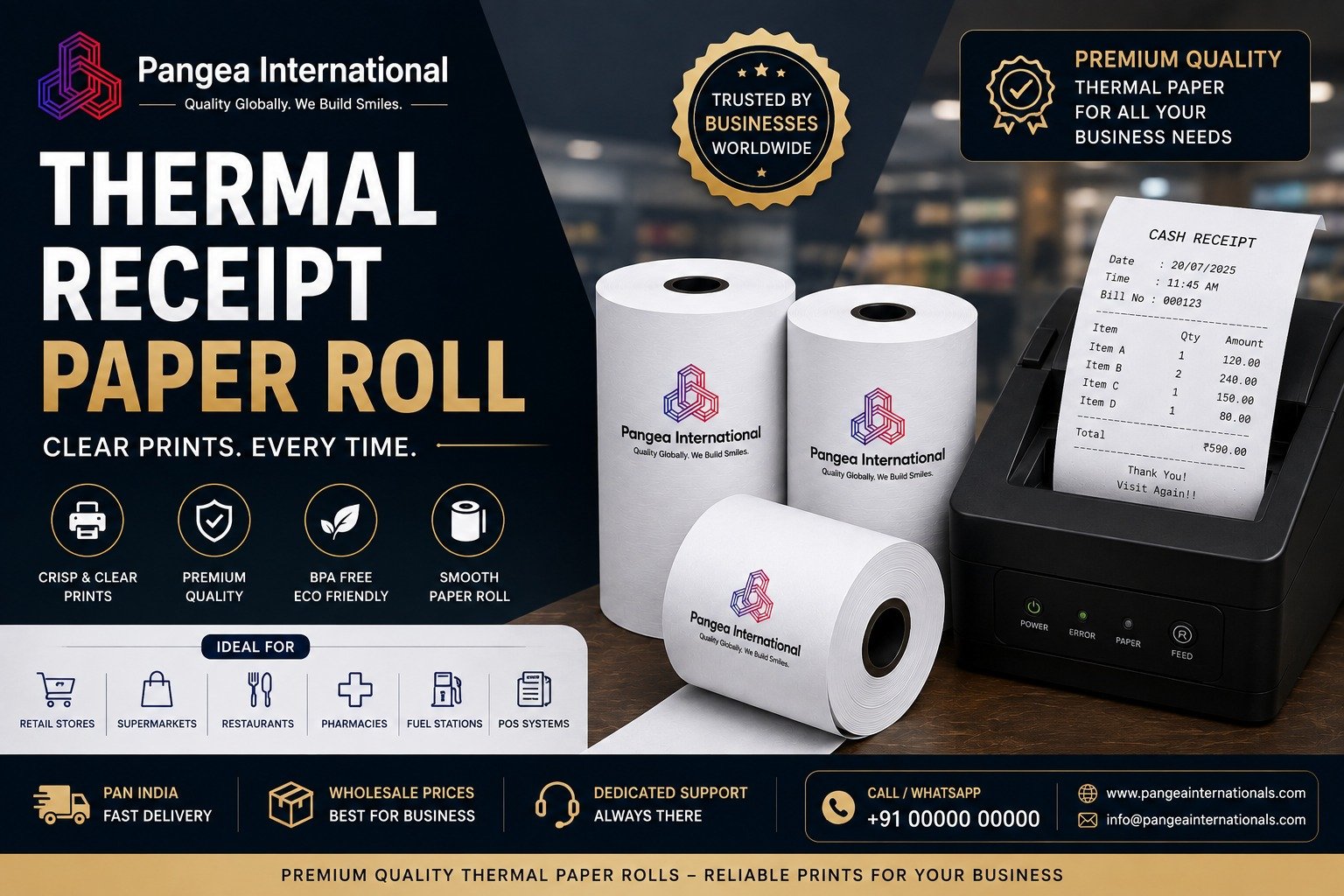
Walk into any shop, restaurant, pharmacy, or delivery hub across Gujarat and you will find a thermal receipt paper roll loaded into a printer somewhere on the counter or in a rider's bag. It is one of those products every business uses constantly and thinks about rarely, right up until a roll jams mid-transaction or a batch of receipts fades within days of printing.
This guide breaks down exactly what this paper is, how it actually works, the different sizes and grades available, and how to choose the right specification for your printer and business volume. We wrote it the way we explain things to first-time customers at Pangea Retails, in plain language, covering the practical questions that actually come up when a business switches suppliers or expands to a new counter, along with a few troubleshooting basics most catalogues skip entirely.
By the end, you will understand enough about width, GSM, coating, and core size to compare suppliers confidently, you will know how to diagnose common printer problems that trace back to paper quality rather than hardware, and you will know exactly what to check before placing your next bulk order of thermal receipt paper roll stock for your business.
What Is a Thermal Receipt Paper Roll?
A thermal receipt paper roll is a roll of specially coated paper used in thermal printers, the kind found in billing counters, handheld card machines, ATMs, and ticket printers. Unlike regular printer paper, it requires no ink, toner, or ribbon; the printer head applies precise heat to specific points on the paper, triggering a chemical reaction in the coating that produces visible text.
This coating is what makes the paper "thermal" in the first place, and it is also what separates a good roll from a poor one on the counter. Two rolls can look identical in width and length while behaving completely differently once loaded into a printer, because the coating formulation, base paper quality, and manufacturing consistency vary considerably between suppliers, sometimes even between batches from the same supplier.
Because the technology is so widely adopted, a huge range of devices, from supermarket billing counters to taxi meters to diagnostic lab printers, rely on some version of this paper every single day. Understanding the underlying mechanics helps explain why certain specifications matter far more than others when you are comparing options.
How Thermal Printing Actually Works
The coating on this paper contains a dye and a colour developer, kept separate at room temperature so the paper stays blank. When the printer head heats a specific spot, typically to around 70-90 degrees Celsius depending on the formulation, the dye and developer react instantly to form dark text at that exact point.
This is why thermal printing is so fast compared to inkjet or dot-matrix alternatives; there is no mechanical impact, no drying time, and no moving ink cartridge, just a print head moving across the paper at high speed. It also explains why thermal receipts fade over time: heat, light, and friction can all trigger the same chemical reaction in unwanted places, gradually degrading the printed text.
Print head resolution, usually expressed in dots per inch, determines how sharp text and barcodes appear on a printed receipt. Quality receipt paper paired with a well-maintained print head produces crisp, scannable barcodes and clear text, while a mismatched pairing of low-grade paper and an older printer often results in smudged or faint output that frustrates both staff and customers.
Print Head Care and Why Paper Quality Affects Printer Lifespan
The print head is the most expensive component in any thermal printer, and paper quality has a direct, cumulative effect on how long it lasts before needing replacement. Low-grade, poorly coated paper often contains more surface debris and inconsistent coating thickness, both of which accelerate wear on the print head's heating elements over thousands of print cycles.
Receipt paper manufactured to a consistent standard reduces this wear considerably compared to inconsistent, budget stock sourced from whichever vendor happens to be cheapest that month. Businesses that switch to a reliable, consistent supplier often report fewer print head replacements over the life of a printer, even though the paper itself is a small fraction of the printer's total cost.
Cleaning the print head periodically with an isopropyl alcohol swab, as most printer manuals recommend, also helps maintain print quality regardless of paper grade, though this maintenance step cannot fully compensate for consistently poor paper if a supplier's stock varies significantly from batch to batch.
Common Sizes of Thermal Receipt Paper Roll
Width is the single most important specification, since it determines whether a roll physically fits your printer at all. Globally, the vast majority of devices use one of two widths, though several other sizes exist for more specialised equipment.
|
Width |
Typical Devices |
Common Lengths |
|
57mm (2 1/4") |
Handheld card machines, taxi meters, ATMs, courier apps |
15m, 20m, 25m, 30m, 40m |
|
79mm/80mm (3 1/8") |
Countertop billing printers, restaurants, supermarkets |
40m, 50m, 60m, 80m |
|
76mm (3") |
Older cash registers, certain legacy POS models |
30m, 40m |
|
112mm (4") |
Specialised kitchen order printers, some banking terminals |
25m, 30m |
For most retail and delivery businesses in Gujarat, the choice comes down to 57mm or 80mm, and the decision is made almost entirely by the printer hardware rather than personal preference. A handheld card machine or a compact billing device will specify its exact width requirement in the manual, and no other size of this paper will load correctly regardless of price or paper quality.
Roll diameter matters just as much as width for a different reason: a longer roll of the same width has a larger outer diameter, and compact printer compartments can only accommodate rolls up to a certain size. Always check maximum roll diameter alongside width before ordering a longer length purely to reduce changeover frequency during busy shifts, since a roll that physically cannot close the printer's lid defeats the purpose of ordering a longer length in the first place.
Key Specifications to Check Before Ordering
Every roll in this category is defined by five core specifications, and missing even one can mean a roll that jams, prints poorly, or simply does not fit your device at all.
Width must match your printer's specified requirement exactly, with no tolerance for rounding. Length determines how many receipts you get per roll and how often staff need to reload the machine during a shift. Core diameter, commonly 12mm or 12.7mm for handheld devices and up to 25mm for larger countertop printers, determines whether the roll sits properly on the spindle without wobbling.
Paper GSM, or grams per square metre, affects thickness, durability, and how dark the printed text appears, typically ranging from 48 GSM on lighter, budget-grade stock to 70 GSM on heavier, premium paper. Coating quality affects how well the printed text resists fading over time, particularly in humid or high-heat storage conditions common across much of India for several months of the year.
Thermal Receipt Paper Roll vs Other Printer Paper Types
Businesses new to billing equipment sometimes confuse this paper with other printer consumables, so it is worth clarifying the distinction clearly before placing an order with any supplier.
|
Paper Type |
Requires Ink/Toner |
Typical Use |
Print Longevity |
|
Thermal receipt paper roll |
No |
POS, billing, card machines |
Weeks to months, fades over time |
|
Dot-matrix continuous paper |
Yes (ribbon) |
Older invoicing systems, multi-part forms |
Very long, ink-based |
|
Inkjet/laser plain paper |
Yes |
Office printing, formal documents |
Long, stable |
|
Carbonless (NCR) paper |
No ink, pressure-based |
Multi-copy handwritten forms |
Long, pressure-sensitive |
This paper is the only option among these that works specifically with heat-based printers, and it cannot be substituted with any of the alternatives above without replacing the printer hardware entirely. This distinction matters when staff or new hires unfamiliar with billing equipment place a reorder without checking the printer type first.
Environmental and Sustainability Considerations
Standard thermal-coated paper is generally difficult to recycle through conventional paper recycling streams because of its chemical coating, and many municipal recycling programmes explicitly exclude it from standard paper bins for exactly this reason. Businesses tracking sustainability metrics increasingly ask suppliers about base paper sourcing and end-of-life handling alongside the usual specification questions.
Choosing a heavier, better-coated roll can indirectly reduce paper waste, since fewer misprints and reprints occur compared to using the thinnest, cheapest stock available and reprinting failed receipts repeatedly throughout a shift. Some businesses have also started exploring digital receipt options alongside printed ones, reducing overall consumable usage for customers who prefer an emailed or app-based copy instead of paper.
For businesses that must continue printing physical receipts for regulatory or customer-preference reasons, sourcing from a manufacturer that can speak to responsible paper sourcing practices remains a reasonable middle ground between full digital transition and continuing with unexamined sourcing habits.
BPA-Free Thermal Receipt Paper Roll: A Quick Note on Safety
Standard thermal coating historically relied on Bisphenol A, or BPA, as the colour developer, a chemical now restricted in several major markets due to health concerns around repeated skin exposure. Every roll supplied by Pangea Retails uses a BPA-free coating formulation, tested and documented for every production batch.
We cover this topic in far more depth, including the difference between BPA-free and genuinely phenol-free paper, in our dedicated guide on BPA-free thermal paper. If chemical safety is a priority for your business, particularly in food service, healthcare, or export-facing operations, that article walks through exactly what questions to ask any supplier.
Understanding GSM and Paper Grade in Detail
Lighter GSM paper, typically around 48-50 GSM, is common in high-turnover environments such as quick-service counters where receipts are glanced at once and discarded within minutes. This grade is generally the most economical option for businesses printing very high volumes of short-lived receipts daily.
Mid-range GSM, usually 55-60 GSM, represents the most commonly ordered grade across general retail and delivery use in India, balancing cost with reasonable durability and print darkness for everyday transactions.
Heavier GSM, closer to 65-70 GSM, resists tearing better and tends to hold print quality longer during storage, which matters for pharmacies, clinics, and any business where a printed receipt may need to be referenced weeks after the original transaction for warranty or insurance purposes.
Beyond GSM alone, coating quality varies meaningfully between manufacturers even at the same stated weight. A well-coated roll produces dark, even text that resists fading through a full monsoon season, while a poorly coated one from a budget supplier can turn patchy or grey within days, regardless of the GSM figure printed on the wrapper.
Where Is Thermal Receipt Paper Roll Used?
-
Retail counters: Every supermarket, kirana store, and boutique billing counter in the country depends on a reliable supply of receipt paper for daily transactions.
-
Food service: Restaurants, cafes, and quick-service outlets use it for both customer receipts and, in many cases, kitchen order tickets printed on a separate station.
-
Healthcare: Pharmacies and diagnostic labs print prescription slips, test result summaries, and billing receipts throughout the day using this exact paper type.
-
Banking and ATMs: Micro-ATMs and traditional ATM terminals across urban and rural India print transaction slips on this narrow-format paper.
-
Transport and logistics: Taxi meters, delivery riders' handheld printers, and courier tracking slips all rely on the same compact, portable paper format.
-
Events and ticketing: Parking lots, toll booths, and event entry points commonly use portable thermal printers loaded with this paper for on-the-spot ticketing.
Each application places slightly different demands on paper grade and length, but all of them share the same underlying dependency on a correctly specified, reliably sourced roll to avoid downtime during business hours.
How to Choose the Right Thermal Receipt Paper Roll for Your Business
Start by checking your printer's manual for the exact width, core diameter, and maximum roll size it accepts, rather than assuming based on what a previous supplier delivered. This single step eliminates the majority of compatibility complaints we hear from new customers switching suppliers for the first time.
Next, estimate daily receipt volume honestly. A counter printing under 100 receipts a day is well served by a shorter roll, while a high-volume delivery hub or restaurant kitchen may benefit from longer lengths to reduce how often staff interrupt service to reload a printer.
Then match GSM to how long receipts need to remain legible. Short-lived transaction slips can use lighter, more economical paper, while receipts tied to warranties, prescriptions, or accounting reconciliation deserve a heavier grade of paper that resists fading for longer.
Finally, request a sample before committing to a large order. Running an actual test roll through your printer reveals fit, print darkness, and feed reliability far more reliably than any specification sheet, and a reputable supplier will always be willing to provide one.
Common Mistakes When Buying Thermal Receipt Paper Roll
Ordering purely on price without checking core diameter is one of the most frequent mistakes we see, resulting in paper that fits the width slot but wobbles or jams because the core does not match the printer's spindle correctly.
Buying in small, frequent batches rather than consolidating into a single larger order is another common inefficiency, since it increases both per-unit cost and delivery overhead compared to planning purchases around a predictable quarterly or monthly cycle.
Ignoring storage conditions is a mistake that often goes unnoticed until receipts start fading unexpectedly. Every roll in this category is sensitive to heat, humidity, and direct sunlight, and stock kept near a window or above electrical equipment tends to degrade far faster than paper stored in a cool, dry area.
Finally, some buyers never ask about coating chemistry or BPA-free status at all, treating all receipt paper as functionally identical. As covered above, this is an increasingly relevant question, particularly for food service, healthcare, and export-oriented businesses.
A related mistake is failing to document which specification is in use across multiple locations or printers within the same business, which leads to exactly the kind of inconsistency described in the case study below, where different outlets end up sourcing slightly different paper independently, creating avoidable quality and pricing variation across what should be a single, standardised purchase.
Cost, Bulk Buying, and GST/ITC Guidance in India
Thermal paper products, including this category, generally fall under HSN code 4811 for GST purposes in India, and businesses registered under GST can claim Input Tax Credit on purchases made for business use, provided the order is backed by a valid GST invoice from a registered supplier.
Bulk buying consistently reduces per-unit cost, often more meaningfully than businesses expect before requesting a quote. An order placed in cartons rather than individual rolls typically costs noticeably less per unit once freight and handling are factored into the comparison across a full year of consumables spending.
For multi-outlet retailers, delivery networks, and franchise operations, consolidating purchases of receipt paper stock into a single recurring order across all locations tends to produce the strongest pricing, since suppliers can plan production and logistics around a predictable, larger commitment rather than scattered small orders.
Always request a GST-compliant tax invoice for every order, both to remain compliant and to ensure Input Tax Credit eligibility is not lost due to missing documentation, particularly for a high-frequency consumable purchase that can otherwise slip through routine bookkeeping.
Case Study: Standardising Receipt Paper Across a Multi-Outlet Retail Chain in Gujarat
A regional retail chain operating eight outlets across Gujarat had historically allowed each store manager to source receipt paper stock independently from local vendors, resulting in inconsistent quality, mismatched core sizes across stores, and considerably higher aggregate spending than a centralised approach would have required.
After a head-office review of consumables spending, the chain consolidated its entire requirement with Pangea Retails, standardising on a single specification across all eight locations rather than allowing local variation. This alone reduced per-unit cost by a meaningful margin, since the combined order volume qualified for pricing that no individual outlet could access on its own.
Printer jam complaints across the chain dropped noticeably within the first two months, since every store now used identically specified paper rather than whatever a local shop happened to stock that week. Head office also reported that consolidated GST invoicing simplified monthly reconciliation considerably compared to matching receipts and invoices from eight separate local vendors each month.
The chain now reorders on a fixed quarterly schedule tied to its accounting calendar, eliminating the reactive, last-minute purchasing pattern that had driven up costs and created quality inconsistency across stores for years before the switch.
Staff across all eight locations also received a single shared reference sheet listing the exact specification in use, so any new hire or replacement printer purchase automatically defaults to a compatible order rather than staff guessing based on whatever was available at a nearby stationery shop.
How to Store and Handle Thermal Receipt Paper Roll
Keep every roll in its original packaging until use, away from direct sunlight and heat-generating equipment such as printers, photocopiers, or direct electrical fittings that can pre-activate parts of the coating before printing even begins.
Humidity control matters considerably across much of Gujarat during monsoon months, when sealed storage containers or a climate-controlled stockroom noticeably extend how long a roll retains crisp print quality once finally loaded into a printer for use.
Once printed, avoid prolonged contact between receipts and PVC-based lamination or plastic folders, since this can accelerate fading through a chemical reaction with the thermal coating over time. For businesses needing to retain receipts long-term, scanning or photocopying onto plain paper remains the most reliable archival method, since even well-stored receipt paper will fade eventually.
Troubleshooting Common Printer Issues Linked to Paper Quality
Faint or patchy printing is usually the first sign something is wrong, and while a dirty print head is often blamed first, inconsistent coating quality from a budget supplier is just as common a cause in practice. Before assuming a printer needs servicing, try a sample from a different, known-reliable batch to isolate whether the paper or the hardware is actually at fault.
Paper jams that happen consistently at the same point in a print cycle usually point to a core diameter mismatch rather than a random mechanical fault. If jams started shortly after switching suppliers or receiving a new batch, that timing is a strong clue worth raising directly with whoever supplied the stock.
Receipts that print correctly but fade within an unusually short time, sometimes just days rather than weeks, typically indicate either a lower-grade coating than advertised or poor storage conditions at the point of sale, such as a printer sitting in direct sunlight near a shop window. Isolating which of the two is responsible usually just requires storing a fresh, unprinted roll away from heat and light and comparing fade rates on a test print a week later.
Barcode scan failures on printed receipts, increasingly relevant as more billing systems print QR codes for digital payment confirmation or loyalty programmes, often trace back to print head resolution mismatched with a paper coating that does not hold fine detail well. Businesses relying heavily on scannable codes should test this specifically rather than assuming any thermal paper will render barcodes with equal clarity, particularly if switching to a new supplier or a new printer model for the first time.
Digital Receipts vs Printed Thermal Paper: Do You Still Need Both?
The rise of SMS and app-based digital receipts has led some businesses to ask whether printed paper is still necessary at all, particularly for high-volume, low-value transactions where a customer may not want a physical copy in the first place.
In practice, most Indian businesses still find printed receipts necessary for at least a portion of transactions, whether for regulatory requirements, customer preference, or situations where a phone number or app is not readily available at the point of sale. A hybrid approach, offering digital receipts by default with printed copies available on request, is increasingly common among larger retail chains looking to reduce both cost and environmental impact without removing the printed option entirely.
For businesses considering this shift, it is worth noting that reducing overall print volume does not eliminate the need for reliable paper entirely, since printers still need to be loaded and ready for the transactions that do require a physical copy, whether due to warranty documentation, prescription records, or simple customer request at the counter.
Domestic Manufacturing vs Imported Paper Stock
Some businesses, particularly larger distributors, weigh the option of importing thermal paper from overseas manufacturers against sourcing domestically. Imported stock can occasionally offer marginally lower per-unit pricing at very large volumes, but the calculation rarely stays favourable once shipping delays, customs duties, and minimum order quantities are factored into the true landed cost.
Domestic manufacturing, by contrast, offers considerably shorter lead times, which matters enormously for any business that cannot afford a multi-week gap in receipt paper supply while a shipment clears customs. It also simplifies GST documentation considerably, since domestic purchases involve straightforward GST invoicing rather than the additional import documentation, letters of credit, and duty calculations that come with overseas sourcing arrangements.
Quality consistency is another consideration often overlooked in the initial price comparison. Working with a domestic manufacturer allows for direct communication about specification changes, sample requests, and quality complaints, none of which are practical when a supplier is several time zones away and communicating through an intermediary trading company that adds its own margin and delay to every conversation. For most Gujarat-based businesses, particularly those without the scale to justify container-level import volumes, sourcing from an established domestic manufacturer like Pangea Retails remains the more practical and reliable choice.
Where to Buy Thermal Receipt Paper Roll in India: Why Pangea Retails
Pangea Retails manufactures and supplies thermal receipt paper roll stock across common widths, lengths, and GSM grades, tested for BPA-free compliance and backed by GST-compliant invoicing for every order, whether you need ten rolls for a single counter or a pallet-scale monthly supply for a multi-location business.
Working directly with a manufacturer rather than a reseller means fewer middlemen, more predictable lead times, and pricing that improves meaningfully as order volume grows across successive quarters. You can browse current stock of the 57mm x 25 Mtr POS Roll and the 79mm x 50 Mtr POS Roll directly on the Pangea Retails shop page.
For a deeper look at choosing between narrow and wide formats, our 57mm POS roll buying guide covers specification decisions in more detail, and our piece on why every business should switch to BPA-free paper is worth reading if chemical safety is a priority for your procurement team.
Frequently Asked Questions About the Thermal Receipt Paper Roll
What is a thermal receipt paper roll made of?
It is made of base paper coated with a heat-sensitive layer containing a dye and colour developer that react when heated by a printer head, producing text without any ink or toner.
How long does a thermal receipt paper roll last before fading?
Printed text typically remains legible for several weeks to a few months under normal storage, though heat, sunlight, and humidity can accelerate fading considerably in poor storage conditions.
What sizes does thermal receipt paper roll come in?
The two most common widths are 57mm, used in handheld and portable devices, and 79mm/80mm, used in countertop billing printers, with less common widths like 76mm and 112mm reserved for specialised equipment.
Is a BPA-free thermal receipt paper roll available in India?
Yes, Pangea Retails supplies a fully BPA-free thermal receipt paper roll across common widths, with test documentation available on request for every production batch.
Can I claim GST input tax credit on thermal receipt paper roll purchases?
Yes, GST-registered businesses can typically claim Input Tax Credit on thermal receipt paper roll purchased for business use, provided the purchase is supported by a valid GST invoice from a registered supplier.
Why does my thermal receipt paper roll jam in the printer?
Jamming is usually caused by a mismatched core diameter or an outer roll diameter too large for the printer compartment, rather than the paper width itself, so always check both dimensions before ordering.
Where can I buy thermal receipt paper roll in bulk in Gujarat?
Pangea Retails supplies thermal receipt paper roll in bulk across Rajkot and Gujarat, with GST-compliant invoicing and consistent specifications for businesses of any order size.
Final Thoughts
Choosing the right thermal receipt paper roll comes down to matching a handful of specifications, width, core size, GSM, and coating quality, to how your specific printer and business actually operate day to day, rather than simply chasing the lowest price on a supplier's list. Getting this right the first time also saves considerable staff time and printer maintenance cost over the life of your billing equipment, which is easy to underestimate until a bad batch causes a week of avoidable disruption.
Pangea Retails supplies thermal receipt paper roll stock built around exactly these fundamentals, so businesses across Rajkot and Gujarat can order with confidence rather than trial and error. If you would like a sample before committing to a bulk order, our team is ready to help you match the right specification to your printer and daily volume.